
Building Connection and Support: Black Dads in Loss
A Conversation with Kelly Jean-Philippe, MDiv, Dad Coach
Trigger warning: miscarriage
“Fatherhood took on a different meaning for me after loss. I used to think being a dad meant having living children. Then loss made it clear that fatherhood is not erased by grief, even when the world does not know how to make space for it.” -Kelly Jean-Philippe, Dad Coach, Dad Always
Postpartum Support International (PSI) recently started the Black Dads in Loss Support Group, which helps bereaved fathers find support and provides helpful information to help them navigate the pain of their loss. Why is a group for Black dads so important?
The Black Dads in Loss Support Group matters for several reasons. As the first group of its kind in PSI’s history, it represents an important step toward making quality support more accessible to bereaved fathers in a way that speaks directly to their experience of baby loss. I’m grateful for the opportunity to partner with PSI in creating a space where Black dads can be seen, supported, and connected in the middle of grief that is too often overlooked.
This also matters to me personally. Fathering my first living child during the 2020 pandemic and a period of intense social unrest made me more aware of how necessary the right kind of community can be. There is something deeply protective about being surrounded by people who understand parts of your experience without requiring you to explain everything. In a time when emotional and psychological safety can feel difficult to find, shared experience can help reduce the weight of isolation, misunderstanding, and lack of support. That is true for Black dads in general, and even more true for Black dads grieving the loss of a pregnancy, baby, or child.
Representation matters, too. When I was searching for support after my first two miscarriages, what little I found was helpful, but it was missing something important: the face and voice of someone who looked like me. That kind of familiarity may seem simple, but it carries deep meaning when someone is trying to process something as raw and disorienting as baby loss. Because I could not find a space like Black Dads in Loss when I needed it, I’m grateful to now help build one for other Black dads—especially those who may not yet know how much they will need it.
Support and resources for dads are lacking, even within the field of perinatal mental health. Based on your experience, what does support for dads look like? How is it unique?
Support for dads begins with taking their grief seriously.
That may sound simple, but in the context of perinatal loss, it is still not the norm. Many fathers are treated as secondary grievers, logistical support people, or emotional backup for their partners. People ask how their wife or partner is doing, but rarely care to ask how they are doing. And when dads are asked, the question often comes with a subtext: Tell me you’re okay so I can move on.
Real support for dads creates space for the truth that a father’s grief is not lesser because he did not physically carry the baby. His bond may have formed differently, but it was still real. He may have imagined a future, pictured himself holding that child, made plans, chosen names, prayed, hoped, and rearranged his identity around becoming that baby’s father. When that baby dies, he does not just lose a pregnancy. He loses a child, a future, and a version of himself he had already begun becoming.
Support for dads looks like language, permission, and connection.
It gives men language for what they often feel but do not know how to say: shock, guilt, anger, helplessness, numbness, fear, resentment, spiritual confusion, and the pressure to stay strong for everyone else. It gives them permission to grieve without needing to perform grief in ways others recognize. Some dads cry openly. Some go quiet. Some become task-oriented. Some return to work too soon. Some look “fine” while falling apart internally. Support helps them understand that grief can look different without being absent.
It also creates connection. Many dads are not looking for someone to fix them. They are looking for a place where they do not have to explain why the loss mattered. They need spaces where other men understand the strange mix of loving and hurting deeply, and feeling unsure of how to handle all of it all at once.
What makes support for dads unique is that it has to account for how many men are socialized to move through pain. A lot of dads are taught, directly or indirectly, to protect, provide, solve, and remain steady under pressure. After baby loss, those instincts often intensify. Those things can be acts of love, but they can also become places to hide.
So support for dads has to meet them there. It cannot be assumed. It has to honor their desire to be useful while also challenging them to be honest. It has to make room for both action and emotion, both responsibility and vulnerability.
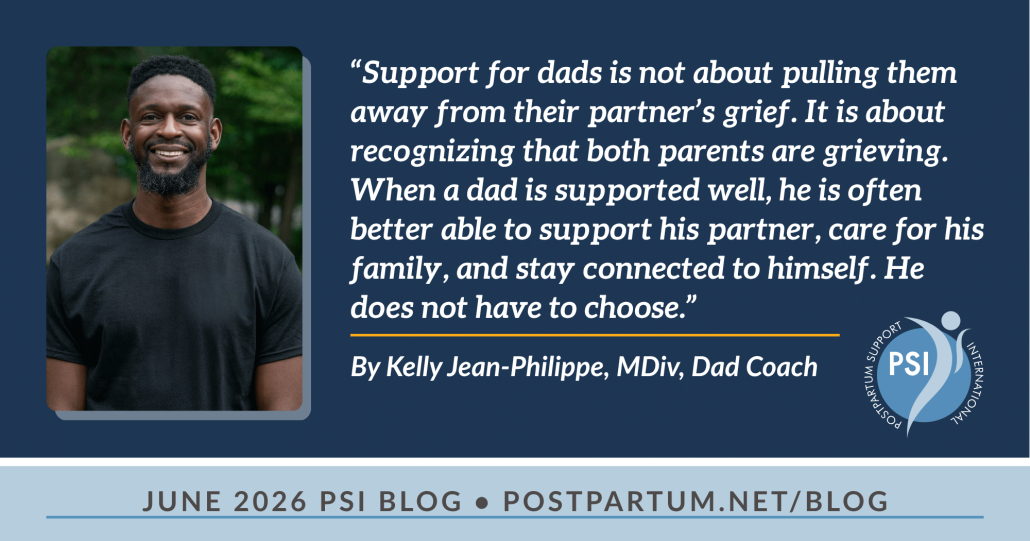
Support for dads is not about pulling them away from their partner’s grief. It is about recognizing that both parents are grieving. When a dad is supported well, he is often better able to support his partner, care for his family, and stay connected to himself. He does not have to choose.
How has your experience as a healthcare chaplain prepared you for this work?
Chaplaincy taught me not to assume I have the answer, the solution, or even the right interpretation of someone else’s pain. I entered the work with that kind of confidence, and I learned quickly how dangerous it can be. Over time, I also came to understand that none of us truly shows up as a “blank canvas.” I can only enter the room as myself—a person shaped by my own story, my experiences, and the lessons I am still learning from them.
One of the greatest gifts chaplaincy has also given me is the chance to better understand myself through every person I have had the privilege to encounter. That is how I approach this work: not as someone who arrives with easy answers, but as someone willing to be present, curious, and honest enough to want to be shaped by what is raw, real, and deeply human in another person.
Tell us about building Dad Always: coaching for dads experiencing miscarriage, stillbirth, TFMR, NICU, and infant loss.
Dads navigating baby loss often have nowhere to bring their grief, even as that grief raises deep questions about identity, purpose, and how to keep living after their world has changed. Losing a child creates a profound shift in how a person sees himself, his future, and his place in the world. At some point, many dads come to a painful but defining crossroads: will I resist the reality that this loss has changed me, or will I learn how to carry that change with honesty, strength, and meaning? Dad Always was built from that crossroads. It exists to help grieving fathers face that shift without having to do it alone.
How is peer support different from group therapy? What can attendees of the Black Dads in Loss group expect?
Group therapy typically involves one or more licensed therapists providing clinical care to a group of clients at the same time. I want to be clear that Black Dads in Loss is not group therapy, and I am not a licensed therapist. That means I do not offer therapy services, diagnose, treat, or operate a clinical practice.
At the same time, I know from conversations with other men that the word therapy can create a barrier for many reasons, including but not limited to past negative experiences. For some men, anything connected to therapy can feel overly clinical, sterile, or intimidating before they even access the space. That is not a criticism of therapy. In fact, I often feel more comfortable entering a coaching or support relationship with a dad who is already connected to individual therapy, because therapy can be a deeply important part of healing, as it has been for me.
Peer support is different. It is not a clinical environment. It is a shared space where people with a common experience come together to speak honestly, listen deeply, and feel less alone. In Black Dads in Loss, I facilitate the group as someone with both personal and professional experience supporting families through baby loss.
The purpose of this group is not to fix one another, give advice, or solve each other’s grief. It is to create a space where Black dads can be seen and acknowledged exactly where they are—as fathers grieving and loving the precious child or children they carry, whether physically, emotionally, or in memory.
Dads who have experienced the loss of a pregnancy or infant are facing challenges of navigating life after loss, all while carrying grief. What is one thing you want grieving dads to know?
I could answer this question in a hundred different ways, but I’ll share a personal story instead.
One of the miscarriages my wife and I lived through happened on a morning when we were both getting ready for work. Our firstborn was a little over a year old at the time, and our routine was simple: get him ready, drop him off at my in-laws’ house, then head to work.
A few days earlier, we had been told the pregnancy was not viable. I remember feeling the weight of being back in a place I already knew too well. My wife had scheduled the D&C, and in the meantime, we were trying to move through life as usual—only everything felt dimmer.
What I still remember most clearly from that morning is the sound of my wife’s voice calling out to me from the downstairs bathroom. I was upstairs with our son, moving through our normal routine, when I heard her cry out. I must have flown down the stairs. When I reached her, she was on the bathroom floor, writhing in pain. Her body had begun to pass the embryo.
I froze.
The shock of what was happening, the intensity of her pain, and the helplessness of the moment pinned me in place. Then I remembered our son upstairs. Suddenly, I was standing in the middle of an impossible decision: stay with my wife while she was actively miscarrying, or get our son out of the house so he would not be exposed to the pain and fear unfolding downstairs.
I chose to take him to his grandparents.
That meant leaving my wife alone, even if only for a short time, in one of the most painful moments of her life and mine.
My in-laws did not know she had been pregnant, so I had to drop him off without giving any real indication that something terrible was happening back home. I rushed back as quickly as I could. When I returned, I found my wife right where I had left her, on the bathroom floor.
And again, I froze.
I did not know what to say. I did not know what to do. I could not fix it. I could not make the pain stop. I could not make the loss and the scene untrue. The only thing I knew to do was lie down on the floor next to her and cry with her.
That image—me lying on the bathroom floor beside my wife—is what I want grieving dads to understand.
There are moments in grief when strength does not look like having the answer. It does not look like fixing the problem, taking control, or finding the right words. Strength looks like surrendering to the truth that you are powerless to make the worst thing better, but you are still present. You are still there.
That moment exposed something in me that I think many men eventually confront. So much of how we understand ourselves is tied to our ability to solve, protect, provide, and turn chaos into something manageable. But baby loss does not respond to any of that. It is not a problem to be solved. It is not a situation that can be organized into clean steps. It is devastating, disorienting, and beyond anything conventional strength can contain.
In that bathroom, I discovered a different kind of strength. Not the strength to fix what was broken, but the strength to stay present in the breaking. Not the strength to make grief smaller, but the strength to let love remain visible inside of it.
Accepting that I could not make the loss better did not make me weak, although that’s how I felt. It connected me to a deeper strength than I had known before—the strength to be honest, to be vulnerable, to accept my powerlessness, and to remain close when everything in me wanted to escape the helplessness of the moment.
What else would you like to share with us?
I care deeply about fatherhood in all of its complexity—the beautiful parts, the painful parts, and the parts many dads are never invited to speak about. I care especially about fathers whose experience of fatherhood has been shaped by baby loss and grief.
Whether through Black Dads in Loss, the Dad Always podcast, or coaching support through the Dad Always website, my goal remains the same: to help bereaved dads find language, connection, and steadier ground as they learn to live in an honest relationship with their loss.
About the Author

Kelly Jean-Philippe, Mdiv, Dad Coach
Kelly Jean-Philippe, Mdiv, Dad Coach, is, first and foremost, a husband of eight years to his wife, Rose; father to two living children, Julius’Camillo and Eden; and cat-dad to Jackpot. After experiencing five miscarriages while growing their family, Kelly came face-to-face with a painful reality: fathers are often expected to grieve quietly, if their grief is acknowledged at all.
Those losses reshaped his understanding of fatherhood, grief, and what it means to keep loving a child who is no longer physically here. In response, Kelly founded Dad Always—a space created to support grieving fathers with language, connection, and steadier ways to carry their loss without having to defend it.
Through Dad Always, Kelly helps dads feel less alone, less overlooked, and more equipped to honor both their grief and their fatherhood.
Interview conducted by Postpartum Support International’s Samantha Reaves, MA, PMH-C.
Explore these PSI Resources:
Black Dads in Loss Peer Support Group
Resources for BIPOC Families
Resources for Dads
Subscribe to the PSI Blog

Connect by PSI
Download our free app “Connect by PSI” in your app store to access PSI support, resources, and information in the palm of your hand.


![“Cactus In Bloom works to increase awareness and disrupt the cycle of child sexual abuse on a systemic level by filling the gap in care for [survivors] who are family planning, perinatal, and parenting, and shaping a culture that has the tools to actively disrupt childhood sexual abuse.” Disrupting the Intergenerational Cycle of Childhood Sexual Abuse A Conversation with Ebony Williams, LMFT, Founder and Executive Director of Cactus In Bloom](https://postpartum.net/wp-content/uploads/2026/06/Disrupting-the-Intergenerational-Cycle-of-Childhood-Sexual-Abuse_Williams.png)
