
DadCare: Bringing Fathers Into Pregnancy
A Conversation with Dr. Edward Stephens, OB-GYN, Psychiatrist
“Fathers feel the weight of new parenthood too—but their struggles often go unseen. When we support dads early, we empower families, ease the load on mothers, and create healthier beginnings for children. The [Bringing the Father into Pregnancy] BFIP Kit makes that support simple, timely, and long overdue.” —DadCare
Dr. Stephens, tell us about DadCare – designed to assess risk, spark dialogue, mobilize resources, and strengthen families.
DadCare, or ‘The Wholistic Management of pregnancy,’ is a set of ‘Yes’ or “No’ questions for the father at the first pregnancy visit and after the delivery.
What in the world is a ‘Wholistic management of pregnancy?’
Let’s start with the birth announcement: “HONEY, I’M PREGNANT!”
Now, let’s go to a realistic pregnancy announcement:
“HONEY, WE ARE PREGNANT!”
That is the message of the Wholistic Management of Pregnancy, Dadcare.
A Wholistic vision of pregnancy acknowledges the genetic and epigenetic realities. The mother and the father are equal contributors in their own way. The mother contributes 50% of the genes, 50% of the epigenetic experience from her life, and carries the pregnancy. The father contributes 50% of the genes, 50% of the epigenetic experience from his life, and may experience physical changes like decreased testosterone and increased stress hormones. Both experience a vastly altered landscape of responsibilities.
We know this mother/father and fetus connection is real:
- Postpartum depression (PPD) in the mother creates a 50% chance of PPD in the father
- PPD in the father creates a 50% chance of PPD in the mother
- PPD in either parent increases the chance of premature delivery
- Depression in either parent increases the risk for depression for the child in childhood or later in life
At a glance, the current management of pregnancy is myopic. It is a shortsighted view of pregnancy as a medical event.
Wholistic Management of Pregnancy sees pregnancy as a psycho-biological happening that immerses both parents, each in their own way, with risks and consequences that reverberate between them.
A Wholistic vision of pregnancy – an interconnected, complementary, and entwined “pregnant couple” – enables the health care provider to assess total risk, raise concerns that spark dialogue with the couple, and mobilize resources to improve the health prospects for the emerging family.
What are the benefits of Bringing the Father Into Pregnancy (BFIP)?
The first benefit that comes to mind is the feeling for the couple that they are in this together. What do mothers-to-be want? They want partners!
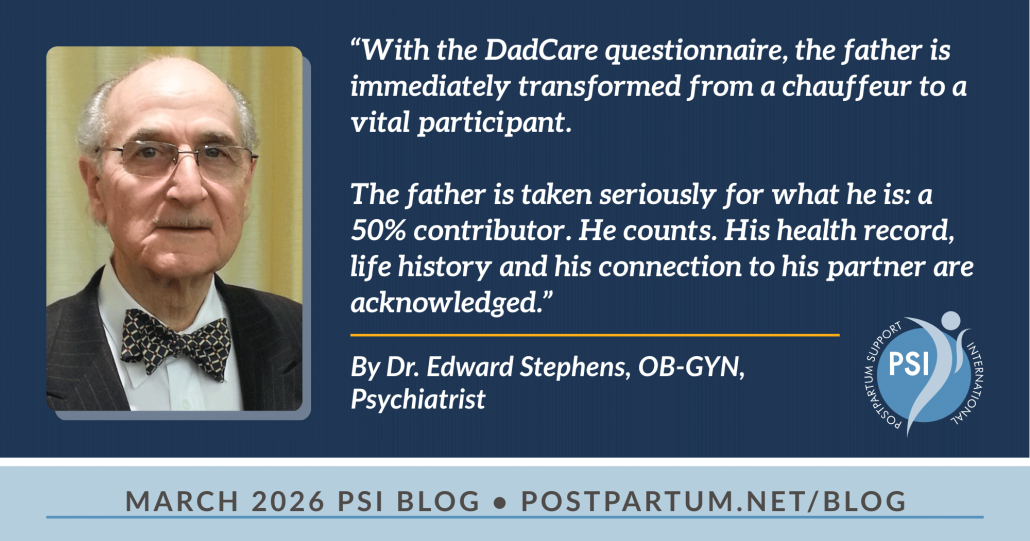
With the DadCare questionnaire, the father is immediately transformed from a chauffeur to a vital participant.
The father is taken seriously for what he is: a 50% contributor. He counts. His health record, life history and his connection to his partner are acknowledged.
The invisible world of the father’s inner experience of being on the threshold of a whole new life, a family, a new meaning for his instincts to provide and protect, along with his concerns and vulnerabilities, is recorded as part of the medical record.
The experience of becoming a father is like a journey into a new world for which the father has no words, no formed feelings.
The DadCare questions create words and senses of himself and his relation to his partner that he could not even begin to imagine, because becoming a father is a voyage into the unknown. After the questions, the father is journeying into the unknown with the mother, who is on the same journey in her own way.
Beyond this, the DadCare questions open the potential to evaluate both the father’s vulnerabilities and his strengths.
Making the father’s health history part of the medical record is nothing more than good medical practice. The father’s health going into the pregnancy is as important as the mother’s health. The father’s mental health history is equally important. The psycho/social/work aspects of his life are also central to the successful, healthy outcome of the pregnancy.
The father’s life experience, epigenetic history, adverse experiences in childhood, history of family breakup in divorce, work history, sense of job security or insecurity, feeling of family support, capacity to talk openly to his partner, are all relevant to pregnancy outcome and are all touched on in the questionnaire.
Through the questions, the father has words to describe the relevant aspects of his felt experience in life. The invisible pregnancy world of the father becomes clear to him, his partner, and the health care provider. Healing difficulties can start and strengths can be highlighted.
Pregnancy care without the father, or with the father as a visitor, is like being a person with only one leg: the one-legged person limps.
DadCare is easy to integrate into any OB-GYN, family practice, or perinatal setting. Can you explain what this integration process looks like?
The way I see it done is with two clipboards!
Each of us is familiar with the first visit to a new doctor. The receptionist hands us a clipboard with health questions.
With the new vision of the pregnant couple, there are two clipboards: ‘His’ and ‘Hers.’
The mother gets the American College of Obstetrics and Gynecology form for pregnancy. The father gets the DadCare questionnaire. Both the mother and the father fill out their questionnaire before they meet the health care provider. They both go into the visit with their vital information recorded.
The difference now is that the father’s record is accorded real importance.
In the before pregnancy questions, the father has answered ‘Yes’ or ’No’ to eighteen questions.
At a glance, the provider can calculate the number of symptom-positive answers from the father and determine the likelihood of complications arising with the father that will affect the outcome of the pregnancy.
In every Wholistically managed pregnancy, a plan is generated for both parents.
Now, the same set of social supports that are in place for the mother in every pregnancy can be brought into play for the father, with the understanding that the wellbeing of the mother and father are intertwined.
Your DadCare kit includes questionnaires for dads – a set of questions for before delivery and after delivery. How are these questionnaires administered? For example, are the questions asked during the appointment, or do dads fill out the questionnaire at home?
The answer is, of course, two clipboards.
But, as always, the devil is in the details.
Maybe the father is reluctant to participate.
Wow! Already, that is vital information about the father’s psychology, his state of mind, or his perspective on his role in the pregnancy.
More commonly, the father is an eager participant and deeply appreciative of his promotion from ‘helper’ to vital agent.
If the father doesn’t come to the visit, the questionnaire can be given to the mother to take home and filled out for the next visit.
In the event that there is no identified father, the mother can answer the questions for the absent father to the best of her ability.
Since there are no single mothers, there is always a partner – present, absent, biological, or same-sex, for whom partner inclusion is relevant.
The same process takes place after delivery.
After delivery, during the lying-in, or at the first aftercare visit, the second set of questions is given using the same two clipboards.
The difference between before and after is that the equation of risks has changed from virtual to actual. The infant is here, and the parenting has begun.
There are eleven after questions with the same ‘Yes’ or ’No’ answers. With these answers, however, unlike the before questions, even one symptom-positive answer indicates the actual presence of PPD.
Bringing the questionnaire home to the absent or reluctant father promotes father inclusiveness. In a world where fatherlessness is a plague on children, DadCare might be the spark that brings the father home. Fatherhood acknowledged is fatherhood strengthened.
Questionnaire responses become part of the patient’s official medical record. Can you explain how this works? Are there issues of confidentiality? Is the father’s information protected by HIPAA?
Neither the “medical record” nor HIPAA is magical.
The medical record is no more or less than what the doctor records for the visit. A complete medical record is one that includes all the relevant information to the condition. In the case of pregnancy, the danger in a medical record is the omission of important information. In pregnancy, omission of the information on the father (a 50% participant) is certainly the definition of an incomplete medical record, like a visit to a cardiologist without listening to the heart.
HIPAA is simply meant to guarantee that medical information will not be disclosed to third parties without the patient’s permission. It has no more or less significance for the father’s information and is meant to be a safeguard for patients rather than a hindrance to the examination process.
Time constraints are commonplace in a medical practice. How would you respond to a provider who is interested in DadCare but may be concerned about how to implement it within the patient’s appointment time?
Two clipboards and a glance at the father’s information to make a comprehensive plan for pregnancy management seems highly efficient to me as a clinician.
This is also a moment when “an ounce of prevention is worth a pound of cure.”
The whole point of pregnancy care is to ensure a safe outcome.
What is the most likely complication of pregnancy? PPD.
When we consider that, conservatively, there is a 15% chance of PPD for the mother and, conservatively, a 10% chance of PPD for the father, we come up with a 25% chance of PPD in any given pregnancy. When we add the known fact that the occurrence of PPD in either the father or the mother predicts a 50% chance of PPD occurring in the other parent, we easily conclude that PPD is by far the most likely serious complication in pregnancy.
Personally, speaking as a doctor, “important” is not the word I would use to describe the information gathered through a Wholistic examination of a given pregnancy.
“Vital,” “crucial,” and “potentially life-saving” are better descriptors of an enhanced examination of the pregnant couple.
Evaluating the effectiveness of healthcare management is always based on outcomes. Pregnancy care is meant to avert poor outcomes, diminished health prospects, complications, and potentially life-altering consequences to one of life’s natural processes.
There is a maternal mental health crisis in the U.S. One in five moms suffers from perinatal depression or perinatal anxiety and faces barriers to receiving specialized care. What would you tell someone who may view DadCare as taking the focus off mothers in crisis?
This concern is a reflection of what is known as “zero-sum thinking.” The argument is that if you do something for one parent, you take something away from the other parent.
The truth of the matter, especially when the lives of both parents are at stake, is that doing anything for one parent is adding to the wellbeing of the other.
The crisis in maternal mental health has deep roots in the absolute neglect of care for pregnant mothers. It can be seen across the country in maternity care deserts where entire counties do not have a single maternity care provider and pregnant women have to travel hundreds of miles for a safe delivery.
To take the position that bringing the father into pregnancy would detract from concern for mothers is absurd!
At the current time, bringing the father into pregnancy actually adds another source of advocacy on behalf of the mother.
One study I read regarding father inclusion being an important factor in maternal care is startling.
The setting of the study was a country and cultural system in which the father was exclusively a bystander. The father’s participation was limited to whether or not he contributed any financial support to the mother. The astounding findings were that in every situation where the father contributed to the mother’s care, in any way or in any amount, she received markedly improved care.
Conversely, when the father did not contribute anything, the mother’s care was significantly diminished and inferior.
Recently, I read an op-ed in the Amsterdam News that said it all: We can save Black mothers—if we better prepare Black fathers.
“As a Black father sitting in countless doctors’ offices alongside my partner, I often found myself invisible—treated like a visitor instead of a vital part of the care team. I watched professionals speak over me, around me, but rarely to me. Even with doulas and midwives present, their focus centered on my partner’s pregnancy journey. Despite being her biggest advocate, I was often left unacknowledged and underdeveloped. No one was teaching me how to navigate hospital systems confidently, advocate for her safety, or care for her body and spirit during and after birth.” (Joshua Liston Zawadi, Amsterdam News, January 8, 2026)
Needless to say, this is not a Black or White issue, but one where father inclusion in pregnancies of cultural minorities may benefit greatly.
Mothers want partners! Bringing the father into pregnancy is a win for the mother, the father and the unborn child!
Screening fathers reduces the overall risk to mothers!
You address pregnancy as a “shared biological and emotional event.” Can you reiterate the importance of transforming dads from bystanders to participants, and how DadCare can facilitate care for the struggles dads face?
I have a two-part answer: as a doctor who has delivered hundreds of babies and as a three-time father who lived through unacknowledged PPD in two of the pregnancies.
First, the story of my choice of psychiatry as a specialty began in my obstetrics training. The emotional needs of the mothers inspired me to reach out for psychiatric consultations on so many occasions that I became familiar with mental health interventions. At the same time, I saw how helpful this support was to the mothers and how much good sense the psychiatric consultants brought to the emerging family. Simply put, I decided I wanted to be a psychiatrist.
My personal journey began many years before my work as an obstetrician. I was 25 when I had an unexpected pregnancy. We tried to get married. Lack of resources and dire family opposition, from both sides, forced a separation between loving young people and the eventual adoption of the newborn.
Now, as I write this, I know that I would have answered the DadCare questions to indicate an unambiguous diagnosis of PPD.
The pregnancy was unplanned, resources were nonexistent, and there was no family support (three symptom-positive answers).
We were not only traumatized by the pregnancy. The emotional trauma persisted for decades until the adopted child found her way back to me when she was 42 years old. The unacknowledged PPD of this first pregnancy became a trigger for PPD in my next pregnancy. DadCare would have made this risk profile clear and treatable.
My next PPD experience occurred with the second pregnancy, 15 years later. If I had taken the DadCare questionnaire, I would have again been diagnosed with PPD on quite different grounds. In the second pregnancy, I had a new set of risk factors. I had a previous episode of PPD, I was inordinately stressed by the pregnancy, the pregnant mother was depressed, and the pregnancy was complicated by physical illness in the mother.
What is even more astounding is that my mental health provider at that time did not recognize my PPD, so I felt shamed and blamed for my stress-related behaviors.
From these real-life, personal examples, it is clear that while pregnancy is a biological phenomenon, it is embedded in the emotional context of the mother’s and father’s lives. How the partners see themselves and the pregnancy is not like a trip to the park. It is the culmination of their personal makeup, their response to novelty, and their relation to each other. In short, the psychology of the partners is as important a determinant in the pregnancy as the partners’ physical health.
Psychology can’t be seen. The father’s and mother’s psychology are invisible to the naked eye. The secret world of the father’s and mother’s concerns requires the special lens and insight that DadCare offers.
A truism that I made a part of my work with couples is “A problem shared is a problem halved.” The DadCare questionnaire makes invisible problems visible, and through sharing, lightens each partner’s burden and offers a dialogue with the partner and the healthcare team. The process heals where healing is necessary and prevents difficulties from becoming health hazards.
How can providers learn more information and take the next steps to become a Father-Inclusive DadCare Safe Haven?
If you are reading this DadCare narrative, you care. You owe it to yourself to seize this opportunity to be part of an enhanced care family of pregnancy support. The DadCare workbook and guide has before and after questions together with an explanation of the significance of each question, which goes beyond the surfacing of potential problems. Every question offers opportunities to help the couple grow to meet the moment of pregnancy, as well as develop capacities for listening to each other that will be invaluable in building their family.
It is in this sense that I describe pregnancy as a “threshold event.” Pregnancy, seen as a psycho-biological event, managed holistically, becomes a gateway.
DadCare.org is the official site to obtain all of the materials.
When you hold the material in your hands, introduce it into your practice, formally or informally, you will see that this real-life approach to the pregnant couple makes a tremendous difference as a care agent.
Is there anything else about DadCare, BFIP, or paternal mental health that you would like to share?
Each of us has a mattering instinct. We want to matter in some way to someone and in how we use our lives.
Those of us who have chosen the helping professions feel this on a daily basis with every life we touch.
We want every life touched to leave us better for having met us.
DadCare is more than the Wholistic Management of Pregnancy. It is my legacy after 50+ years as a physician, integrating psychiatry with my own life experience.
My aspiration, for those that have met me through this workbook and guide, is that they will be better for having met me through Dadcare.

Edward M. Stephens, MD
Edward M. Stephens, MD, is an internationally recognized physician and psychiatrist. He has produced a stream of programs about men, women, and families: The Paternal Instinct, Paternal Grief Syndrome, After Divorce: Fathers, Mothers and the Law, and Shattering Fictions and Myths in Divorce. He then turned to the question of The Decline of Males (Tiger) and Why Men Die First (Legato), Why Boys Fail (Tyre), and an intense awareness that men and boys had become “the neglected other half of gender,” according to the World Bank. With no presence of male studies in higher education, and falling prospects globally to the detriment of all, he saw the need to create an educational initiative that would be apolitical, rigorous, and inclusive. Today, Male Studies, A New Academic Discipline and The Foundation for Male Studies, support these efforts.
Interview conducted by Postpartum Support International’s Samantha Reaves, MA, PMH-C.
Explore More PSI Resources:
Perinatal Psychiatric Consultation Program
List Your Practice on PSI’s Provider Directory

Connect by PSI
Download our free app “Connect by PSI” in your app store to access PSI support, resources, and information in the palm of your hand.


