Inside PSI’s Training for BIPOC Professionals
A Conversation with PSI Faculty Kristy Christopher-Holloway, EdD, LPC, PMH-C
PSI is offering special presentations of the Perinatal Mood Disorders: Components of Care and Advanced Perinatal Mental Health Psychotherapy trainings for a BIPOC audience.
The Components of Care training is October 21-22, 2026, and the Advanced Psychotherapy training is October 23, 2026. Both trainings are in Cambridge, MA. Their registration deadline is October 7, 2026.
Q: For professionals working with the perinatal population, specialized training is essential. Will you give us an overview of the content covered in Postpartum Support International’s Perinatal Mood Disorders: Components of Care training?
Kristy: Absolutely! The Components of Care training really provides the foundation professionals need to understand perinatal mental health beyond simply recognizing postpartum depression. It is a very comprehensive, evidence-based training that helps professionals understand the range of perinatal mood and anxiety disorders, how they may present, and how to appropriately screen, assess, refer, and support birthing people and their families.
What I appreciate about the training is that we are not just giving participants information about diagnoses. We are helping them think about the whole person and the entire perinatal experience. We talk about risk and protective factors, treatment and support options, the role of partners and families, and the importance of developing systems of care and referral networks. Participants leave with practical knowledge they can begin incorporating into their work, whether they are mental health professionals, medical providers, birth professionals, doulas, lactation counselors, home visitors, dentists, social support providers, or others who interact with perinatal families.
Q: PSI offers a special presentation of the Components of Care training, delivered by people of color for people of color, with a focus on serving the needs of BIPOC families. The training is open to Black, Indigenous, and other providers of color. Why is this so important?
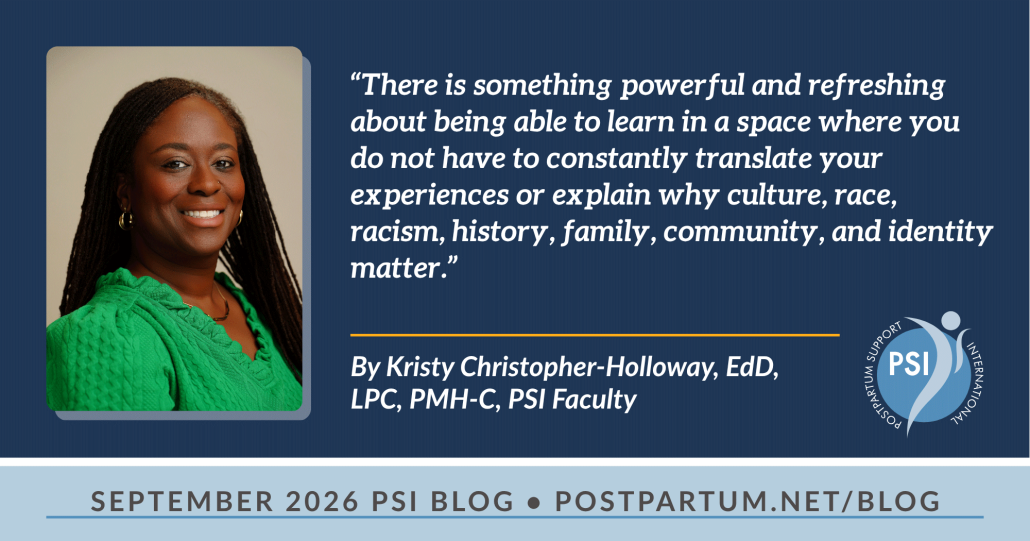
Kristy: There is something powerful and refreshing about being able to learn in a space where you do not have to constantly translate your experiences or explain why culture, race, racism, history, family, community, and identity matter.
Providers of color bring knowledge into the room that comes not only from our professional training, but often from our lived experiences and the communities we serve. Creating an intentional learning space allows us to have conversations that may unfold differently when participants feel culturally understood and psychologically safer to engage honestly.
It also gives us an opportunity to move beyond asking, “What is wrong with this person?” and consider, “What has this person experienced, what systems are influencing their experience, what cultural strengths do they bring with them, and what might I be missing as a provider?”
For BIPOC families, culturally responsive perinatal care is not an optional addition to good clinical care. It is part of good clinical care.
Q: What is covered in PSI’s Advanced Perinatal Mental Health Psychotherapy training?
Kristy: The Advanced Psychotherapy training takes the foundational knowledge from Components of Care and asks clinicians to go deeper into how we actually conceptualize and treat perinatal mental health concerns. The curriculum addresses differential diagnosis, evidence-based psychotherapeutic approaches, and more complex therapeutic issues that arise when working with perinatal clients.
One of the strengths of the training is the emphasis on application. I really like the advanced psychotherapy training because we get to slow things down a bit and actually dialogue more. I get to come off the stage and interact with the participants! We do breakouts to discuss case examples and practical treatment considerations so participants can think critically about what treatment looks like with an actual client, not simply what a diagnosis looks like on paper.
That distinction is important because perinatal clients often come to us with multiple things happening simultaneously: cultural beliefs, identity transitions, relationship changes, anxiety, depression, intrusive thoughts, trauma histories, reproductive loss, infertility experiences, complicated birth experiences, family expectations, and other stressors. Advanced training helps clinicians develop the clinical judgment necessary to recognize those layers and provide more thoughtful, individualized care.
Q: Why is it critical to consider and understand the needs of BIPOC families?
Kristy: This is important because people do not enter pregnancy, birth, postpartum, infertility, loss, or parenthood without their cultural identities and lived experiences.
We cannot provide truly effective care while ignoring the context in which people live and experience their environment. BIPOC families may be navigating racism, discrimination, medical mistrust, inequitable access to care, cultural stigma surrounding mental health, financial or systemic barriers, and experiences of not being heard or believed within healthcare settings. At the same time, their communities may also hold tremendous sources of strength such as faith, spirituality, extended family, cultural traditions, community networks, resilience, and collective ways of caring for one another.
Culturally responsive care requires us to understand both. We cannot focus exclusively on disparities and deficits. We also have to recognize cultural strengths, protective factors, and the expertise families have regarding their own lives.
Ultimately, we have to remain curious enough to ask rather than assume. Cultural responsiveness and cultural humility is not about memorizing facts about different racial, ethnic, or minoritized groups. It is about developing the humility, awareness, and clinical skills to see the person sitting in front of us within the full context of their life that is shaped by their lived experiences.
Q: What are some concrete ways for professionals to apply what they learn in PSI’s trainings?
Kristy: This is actually a challenge I give during training. I ask participants to reflect on what they’ve learned and how they hope to apply it. Start by looking at your everyday practice. Ask yourself: What will I do differently on Monday because of what I learned?
That might mean routinely screening for perinatal mental health concerns instead of waiting for someone to disclose that they are struggling. It might mean becoming more comfortable asking about intrusive thoughts, reproductive loss, birth trauma, or suicidal ideation. It could mean strengthening your referral network so that when someone needs a higher level of care, psychiatric consultation, peer support, lactation support, or another specialized service, you already know where to send them.
Professionals can also examine their paperwork, assessment questions, websites, office environments, referral practices, and treatment approaches. Who is represented? Who is left out? What assumptions are built into our questions? Are we asking clients about cultural identity, spirituality, family structures, community support, reproductive experiences, and barriers to care?
Training is valuable, but training alone does not change outcomes. We have to translate knowledge into practice. Or as I like to say, “don’t talk about it, be about it!”
Q: How do PSI’s BIPOC-focused trainings support culturally relevant and responsive care?
Kristy: The BIPOC-focused training is vital because it creates intentional space for culture to be integrated into the clinical conversation rather than treated as a separate topic that we address at the end.
Participants are encouraged to think critically about how culture, race, identity, history, systems, and lived experience intersect with perinatal mental health. We can explore how symptoms may be understood or expressed differently, how stigma can influence help-seeking, how historical and contemporary experiences with healthcare systems affect trust, and how our own identities and biases influence the therapeutic relationship. Additionally, participants have the opportunity and space to safely and bravely discuss how these same systems and experiences impact them as a provider of color and ways to navigate.
Importantly, culturally responsive care does not mean assuming that every person from a particular racial or cultural group has the same experience. In fact, it requires the opposite. It asks us to remain curious, practice cultural humility, recognize the impact of systems, and allow clients and families to tell us what matters to them.
The goal is not simply to become more knowledgeable about BIPOC communities, but to become better clinicians for the people and families who trust us with their care.
Q: Is there anything else you’d like to share?
Kristy: I can talk about this topic all day, so there is so much more to share! But, I would encourage professionals to think about perinatal mental health training as more than another credential or continuing education requirement. 1 in 5-7 birthing people will experience a perinatal mental health concern, so that means it is extremely likely that a professional will encounter a client who is struggling with perinatal mental health. Specialized training has the potential to change what we notice, what we ask, how quickly we recognize when someone is struggling, and ultimately how effectively we respond.
I also want providers to remember that we do not have to—and should not—do this work alone. Perinatal mental health care works best when we build communities of care—mental health professionals, medical providers, birth workers, lactation professionals, peer-support providers, community organizations, and families working together.
And I think we have to continue asking ourselves a very important question: Who is still not receiving the care they need, and why?
Our responsibility is not only to become more clinically competent. It is to use that competence to help create systems of care in which more birthing people and their families feel seen, heard, respected, and supported throughout their reproductive and perinatal journeys.
About the Author

Kristy Christopher-Holloway, EdD, LPC, PMH-C
Kristy Christopher-Holloway, EdD, LPC, PMH-C, is a counselor educator, the founder and director of New Vision Counseling Center, LLC, and founder of New Vision Consulting and Training, LLC. She is a Licensed Professional Counselor, a National Certified Counselor, a Distance Credentialed Counselor, a Counselor Supervisor, and certified in Perinatal Mental Health. She works with minoritized women experiencing infertility trauma, birth trauma, reproductive loss, and issues related to maternal mental health.
Dr. Christopher-Holloway presents nationally and internationally with a focus on African Americans and mental health, the psychoemotional impact of infertility in African American women, maternal mental health, the strong Black woman syndrome, generational trauma, and more. She has received numerous awards, including the Breakthrough Award for Outstanding Research, in recognition of her work related to mental health and infertility.
Interview conducted by Postpartum Support International’s Samantha Reaves, MA, PMH-C.
The views and opinions expressed in this blog are those of the author and do not necessarily reflect the official policy, position, or views of PSI, its leadership, employees, affiliates, or partners. Any content provided by the author is for informational purposes only and should not be construed as representing PSI’s official stance on any matter.
Explore these PSI Resources:
PSI’s Professional Trainings
PSI Alliance for People of Color
Perinatal Mental Health Certification
Subscribe to the PSI Blog

Connect by PSI
Download our free app “Connect by PSI” in your app store to access PSI support, resources, and information in the palm of your hand.