The Importance of Neuro-Affirming Care in Pregnancy and Postpartum
A Conversation with Alix Myers, Founder and Doula at TENDER.LY
With a focus on neurodivergent family care, birth planning, postpartum well-being, and infant feeding support, Alix ensures every parent feels empowered, validated, and equipped with the tools they need for their unique journey.
TENDER.LY is committed to fostering a diverse, equitable, and inclusive space where all families feel a sense of belonging.
Q: At TENDER.LY, you provide a full spectrum of care—birth planning, feeding support, postpartum recovery, partner guidance, and more. Tell us about the services you offer.
Alix: I like to say I help families feel less alone and more prepared. I support people through pregnancy, birth, postpartum, and infant feeding, but the biggest part of my job is helping them build support that actually fits them. No two families are the same, so their care shouldn’t be either.
Q: Care and support for neurodivergent families is at the center of the work you do. Will you tell us about your neuro-affirming approach?
Alix: For me, neuro-affirming care starts with letting go of the idea that there’s one “right” way to experience pregnancy or parenthood. I spend a lot of time getting curious instead of making assumptions. We work with someone’s brain—not against it—and that changes everything.
Q: How can breastfeeding/chestfeeding look different for neurodivergent parents?
Alix: It can be wonderful, and it can also be really hard. Sensory overwhelm, interoception differences, executive functioning, touch, sound, sleep deprivation—all of those can affect feeding. Take letdown, for example. One parent might describe it as this beautiful rush of connection. Another might say it makes their skin crawl. Someone else might experience significant pain or even agony with every letdown. None of those experiences are wrong. They’re all valid. Once we stop expecting everyone to have the same experience, we can find solutions that actually work.
Q: What are some practical, affirming strategies that providers and families can use to make feeding feel more manageable?
Alix: Honestly, my biggest piece of advice is to plan ahead. Don’t wait until you’re in the thick of postpartum to figure out what you need. Pregnancy is such a great time to get curious about your brain—or, if you’re a provider, your client’s brain. How do you usually do during big transitions? What has helped you through stressful seasons before? What accommodations have made a difference?
Then ask yourself, “What can I do today that my future self will thank me for?” Maybe that’s setting up a cozy feeding station, prepping a few freezer meals, asking a friend to take your toddler to the park once a week, hiring a postpartum doula, or talking with your partner about what overwhelm looks like for you and how they’d know you need extra support.
And let’s talk about food for a second. I promise you, you’re probably not going to want to cook. Figure out how you’re going to feed yourself before the baby arrives. Maybe that’s stocking the freezer, organizing a meal train, asking family to bring dinner instead of baby gifts, or giving yourself full permission to order takeout. Feeding yourself is just as important as feeding your baby.
Postpartum can be incredibly beautiful, but it’s also one of the biggest transitions your body and brain will ever go through. There are huge hormonal shifts, sleep deprivation, new routines, and so much change all at once. We can’t prepare for everything, but we can build a plan that supports us through it. And that’s one of the greatest gifts we can give our future selves.
Q: Do clients need a diagnosis of neurodivergence to benefit from your services?
Alix: Not at all. And actually, this is probably a good place to explain what I mean by neurodivergent families. I’m not just talking about the birthing parent. It could be the birther, their partner, another child in the family—or sometimes all of the above.
I also think it’s important to say that neurodivergence is an identity, not a diagnosis. It’s a term that describes people whose brains or bodies move through the world differently. That might include autism, ADHD, dyslexia, OCD, Tourette syndrome, and so much more.
So with that said, no—you absolutely don’t need a diagnosis to benefit from my support. Neuro-affirming care is really just good, inclusive care. It means paying attention to someone’s nervous system, communication style, sensory needs, and the ways they naturally process the world. Most of the adults I work with don’t have a formal diagnosis, and many haven’t even considered that they might be neurodivergent.
At the end of the day, this work isn’t about labels. It’s about inclusion. It’s about accommodations. And it’s about creating support that meets people where they are, instead of expecting everyone to fit into the same mold.
Q: At Postpartum Support International, we understand the vital importance of social support in pregnancy and postpartum. Tell us about your support circle and baby groups.
Alix: Community has always been at the heart of what I do, but these days I’m spending a lot of my time building community for birthworkers. I run a mastermind for neurodivergent doulas and birthworkers, and I host free webinars every other month to help birth professionals create more neuro-affirming practices.
The reality is that I can only support so many families myself. But if I can help hundreds of birthworkers better understand nervous systems, sensory needs, communication differences, and accommodations, that impact grows exponentially.
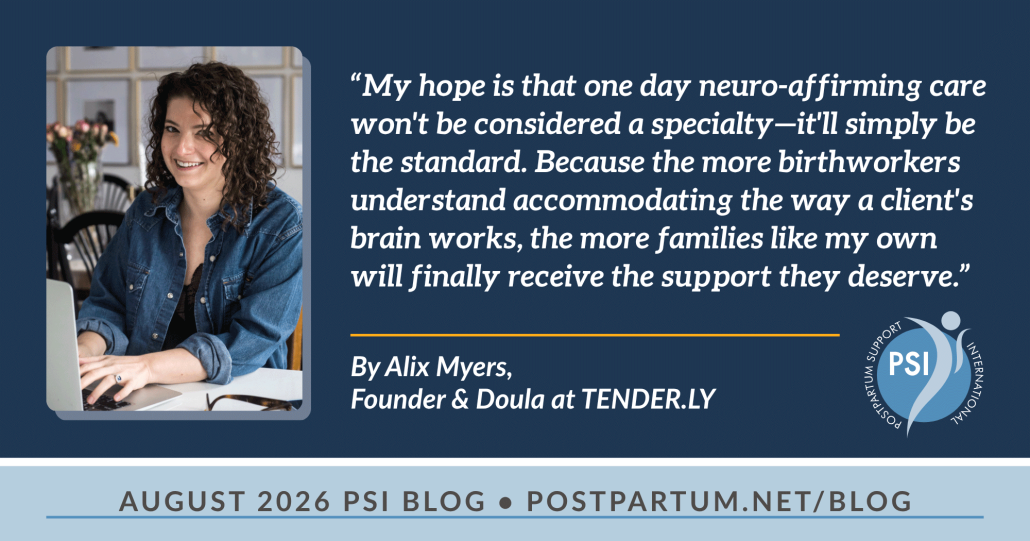
My hope is that one day neuro-affirming care won’t be considered a specialty—it’ll simply be the standard. Because the more birthworkers understand accommodating the way a client’s brain works, the more families like my own will finally receive the support they deserve.
Q: What would you say are some of the most significant barriers to care for new families? How does TENDER.LY address these barriers?
Alix: Oof, this is a hard one. I think one of the biggest barriers is simply a lack of understanding. We’re learning so much about neurodivergence and nervous systems, but that knowledge hasn’t fully made its way into pregnancy, birth, and postpartum care yet. Whether you’re working with an OB, midwife, nurse, lactation consultant, or doula, there’s still a lot of misinformation and a lot of assumptions about what support should look like.
My job is to get curious instead of making assumptions. Every family is different, so I spend a lot of time understanding how their brain works and what accommodations will help them feel safe, supported, and empowered. That’s actually why I created my Neurodivergent Client Intake Kit for doulas. I wanted birthworkers to have practical tools that help them ask better questions instead of making assumptions. Sometimes the smallest accommodation can completely change someone’s experience.
That’s also why I spend so much time educating birthworkers. The more we understand different brains, the better we can support all families.
Q: If you could give one piece of (solicited) advice to a new parent, what would it be?
Alix: Take care of yourself. I know that’s easier said than done as a new parent, but you really can’t pour from an empty cup. If your brain or body needs extra sleep, daily movement, time alone, body doubling, sensory breaks, or a little less noise, listen to it. Those aren’t luxuries—they’re accommodations, and you deserve them too.
We spend so much time talking about what babies need, but not nearly enough time talking about what parents need. Your needs don’t stop mattering the moment your baby is born. In fact, caring for yourself is one of the most important ways you care for your baby.
About the Author

Alix Myers
Alix is a doula and founder of TENDER.LY, where she provides pregnancy, birth, postpartum, and infant feeding support rooted in neuro-affirming care. She supports all families with inclusive, practical guidance that respects individual needs and honors diverse ways of moving through early parenthood. Alix believes that every family deserves compassionate, tailored support that makes them feel capable and cared for. She lives in Hudson, Quebec, with her husband and their three wonderfully neurospicy children. Learn more at www.lovetender.ly.
Interview conducted by Postpartum Support International’s Samantha Reaves, MA, PMH-C.
The views and opinions expressed in this blog are those of the author and do not necessarily reflect the official policy, position, or views of PSI, its leadership, employees, affiliates, or partners. Any content provided by the author is for informational purposes only and should not be construed as representing PSI’s official stance on any matter.
Explore these PSI Resources:
Information on Birth and Postpartum Doulas
PSI Support Programs
Free Peer Support Groups (ADHD Support, Autistic Moms and Birthing People, and more)
Subscribe to the PSI Blog

Connect by PSI
Download our free app “Connect by PSI” in your app store to access PSI support, resources, and information in the palm of your hand.