When “Anxious” Is the Only Word a Mother Can Say
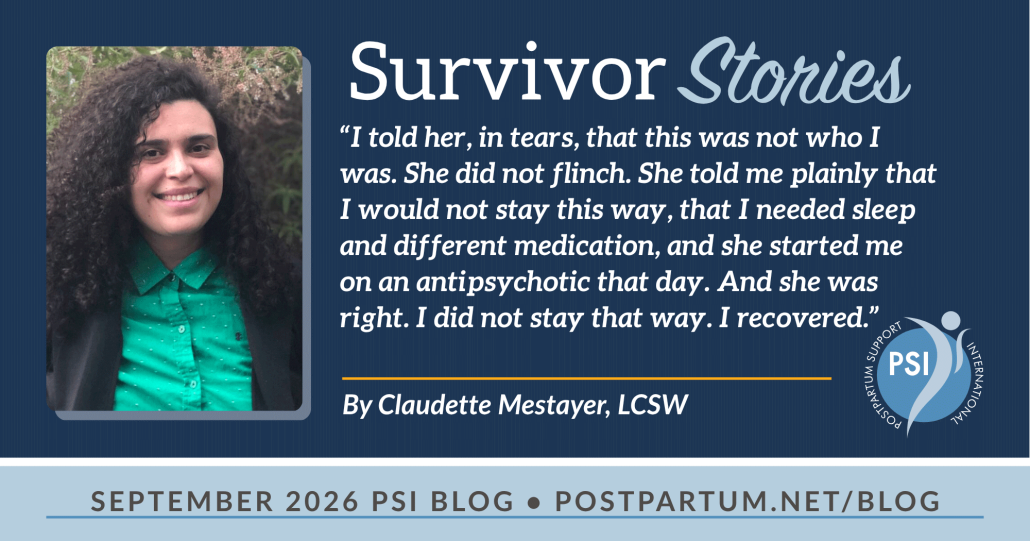
By Claudette Mestayer, LCSW
At PSI, we understand that storytelling has the power to save lives, and we are honored to provide a space for survivors to share their stories. This article is part of a subsection of the PSI blog dedicated to survivor stories. Please note that this story has not been edited, and caution is advised as distressing themes related to perinatal mental health may be present. If there are specific trigger warnings for an article, they will be listed below. Links to resources can be found at the bottom of this page.
Trigger warning: intrusive thoughts, suicidal ideation
For a mother in crisis, a six-week wait can be the difference between recovery and catastrophe
Five years ago, I stood in the shower fighting an internal battle for my life. My son was three months old, the living joy of everyone in the house. I could not feel that joy. I was living with severe postpartum OCD that had turned into psychosis after my antidepressant dose was increased. I did not want to harm my son, but I feared I could. And the thoughts made me want to harm myself.
At my six-week postpartum visit, held over Zoom because of the pandemic, my OB asked how I was doing. I told her I was “anxious.” What I did not say was that my mind had become a nonstop loop of fear that I was a danger to my own child. Even as a licensed clinical social worker, someone trained to recognize exactly what I was experiencing, I could not say it out loud. I was afraid that if I told the truth, I would be hospitalized and separated from my baby. I had worked in those hospitals, and I did not think I belonged there.
My OB offered to connect me with a social worker and a support group. The wait was six weeks.
This is the gap that needs to close: the space between when a mother finally works up the courage to say something is wrong and when she can see someone who actually knows how to treat it. Six weeks is not a long wait by health care standards. For a mother in psychiatric crisis, it can be the difference between recovery and catastrophe.
Connecting with care
I tried what I could reach quickly. Therapy for OCD. Therapy to process a traumatic birth. A meditation program my doctor suggested, which made the delusions and internal looping worse. Eventually, I asked for medication. Twenty-five milligrams of Zoloft helped fast. Then my dose was increased to fifty milligrams, and everything I had been holding together came apart. I felt suicidal. The delusions intensified. Sleep would not come, and when my son cried, it went through me like electricity.
What changed my outcome was not the system. It was two friends, both fellow social workers, whom I told the truth over text. Through that connection, I found a psychiatrist who specialized in postpartum mental health, and I paid for her services out of pocket. She was the first clinician who asked me what I was actually thinking, not just how I was feeling. I told her, in tears, that this was not who I was. She did not flinch. She told me plainly that I would not stay this way, that I needed sleep and different medication, and she started me on an antipsychotic that day. And she was right. I did not stay that way. I recovered.
Mothers in crisis need access to care
I got better because I got the right care fast, and because I was not carrying it alone. My husband heard the treatment plan directly from my psychiatrist and stepped in as primary caregiver while I continued to breastfeed. My mother helped with the baby. My mother-in-law ran the household. It was still a hard road. For a while, I could not shower without my husband sitting on the closed toilet lid a few feet away, because I was too afraid to be alone with my own mind.
Like many of us, I have been following the Lindsay Clancy case, involving the Massachusetts mother whose postpartum psychosis ended in the deaths of her three children. It has brought up many thoughts and feelings, but I am not interested in judging her. I am interested in the fact that our stories started in nearly the same place, and mine did not end where hers did, because I had something she may not have had: fast access to a specialist who took my symptoms seriously, and people around me who could step in and support me.
That access should not depend on whether a mother happens to know two other clinicians, or can pay a psychiatrist directly, or is brave enough to say the unspeakable thing to a doctor she’s known for fifteen minutes on a screen. Every OB and midwife should be trained to ask direct questions about intrusive thoughts, not just mood. A new mother shouldn’t have to wait six weeks to connect with care. We need family psychiatric units where mothers aren’t separated from their babies. And mothers should hear, plainly and often, that having violent or terrifying thoughts about their baby does not mean they are dangerous. It means they need care immediately.
I am alive. My son is thriving. I am not offering my story as the exception that proves nothing can be done. I am offering it as evidence of what happens when a mother in crisis gets the care she needs before it is too late.
About the Author

Claudette Mestayer
Claudette Mestayer is a first-generation Nicaraguan writer, poet, licensed clinical social worker, and educator living in Oakland, California, whose work draws on lived experience and clinical expertise to explore motherhood, mental health, chronic illness, cultural identity, inherited trauma, resilience, and healing. She is currently working on Winter of Becoming: A Memoir of Motherhood, Madness, and Healing, which traces obsessive-compulsive disorder, pregnancy, and postpartum mental health as part of the complicated journey toward healing and self-understanding. Connect with Claudette @therapywithclaudette.
Another version of this blog was originally published on wbur on September 10, 2026.
The views and opinions expressed in this blog are those of the author and do not necessarily reflect the official policy, position, or views of PSI, its leadership, employees, affiliates, or partners. Any content provided by the author is for informational purposes only and should not be construed as representing PSI’s official stance on any matter.
Explore these PSI Resources:
Perinatal Mental Health Training for Professionals
Connect with Support
Learn More About Perinatal Mental Health Disorders
Subscribe to the PSI Blog