
National Infertility Awareness Month & Motherhood After Infertility
By Emily Morehead, PhD candidate, LPC-S, PMH-C
Can you remember when you got the “talk” at school? The good ol’ birds and the bees. Growing up, I only heard about pregnancy as if it were a guarantee. Two people, sperm meets egg, baby in a baby carriage. That simple, right?
But that’s not how reproduction works. And we aren’t to blame.
In the United States, the majority of sex education is abstinence-only. So when family building is attempted, we really lack practical, science-forward information to shape our expectations or know when things aren’t quite right.
April is National Infertility Awareness Month, and about 9% of men and about 11% of women of reproductive age in the United States have experienced fertility problems (Chandra et al., 2013).
The Academy of Reproductive Medicine (2023) shares that Infertility can be defined as:
- The inability to achieve a successful pregnancy is based on multiple factors, including but not limited to your health, age, physical findings, and test results.
- The need for medical help to conceive, like using donor eggs, donor embryos, or donor sperm to become pregnant, either on your own or with a partner.
- For heterosexual couples, if you’re having regular, unprotected sex and are unable to become pregnant, it’s time to seek help. This should start after 12 months if the person with ovaries is under 35, and after 6 months if the person with ovaries is 35 or older.
It’s important to note that infertility is not solely a female issue; it is typically split equally (roughly one-third each) between male-factor, female-factor, and a combination of both or unexplained factors. Individuals across races, geographical locations, genders, and sexual orientations can be impacted by fertility challenges.
Self-Care in Infertility
Mind, body, and soul impact:
When individuals are struggling with infertility, it is important to understand the impact that infertility has on the mind, body, and relationships. Fertility challenges impact individuals’ perception of self, body trust, financial stability, and sexual functioning. Something that was once described to us as simple is now incredibly complex and infiltrates areas of our lives we couldn’t have imagined.
Communication is key:
It’s important to remember that communicating about struggles is important. As isolating as fertility challenges are, navigating the pain alone only complicates the pain further. Individuals should decide who they want to share with, as well as how they want to share the challenges, treatments, and updates, in order to preserve their mental health, as you are on the rollercoaster of fertility challenges.
Say no:
break the societal pressures to say yes to everything. If your life is inundated with baby showers, Instagram baby announcements, and new babies galore, you may need to consider when you want to say yes to a social event centered on pregnancy, babies, and motherhood. Give yourself permission to assess if you want to attend, and why. If you do attend, it’s important to integrate a plan for how you will support yourself before or after a social event and prepare to take care of yourself afterwards. Side note, no is also a perfectly acceptable answer. This journey is hard, and you don’t control how hard it is, but you can take care of yourself along the way.
Family Building Options
If you are going through an infertility journey, it’s important to remember that there is not a one size fits all approach to family building. As you navigate your options for how you want to build your family, remember that there is more than one way to be and to create a family. Discuss with your partner the dream you had for family building, and talk together about openness to adapt as you take this journey.
Many families are built through:
- Third-party reproduction using a gestational carrier (GC)
- Sperm, oocyte, and embryo donation
Adoption (kinship, domestic infant adoption, foster care adoption and international adoption) - Foster parents
- Childlessness
Regardless of how you build your family, it’s important to take care of your relationship and yourself as you prepare to do so. Stay open about your experience, grief, and dreams with your partner and create a space where they can share theirs.
Most importantly, remember, you aren’t alone, and you don’t have to do this alone. Reach out to Postpartum Support International and explore group therapy options to have a safe space to process your feelings and experience with individuals who get it.
Motherhood After Infertility
You worked so hard fighting to build your family, and now you are pregnant. Throughout your journey, you shared that “if you could just get pregnant, everything would be fine.” Yet you may not actually feel fine.
During infertility, so many people learn to survive by putting their head down and just keeping going. And then, when you finally reach what you’ve been working toward, a new chapter begins through pregnancy, birth, and motherhood. It can feel deeply exciting… and, at the same time, unexpectedly overwhelming or even a little terrifying.
First, it’s important to note that this is a very normal experience. Individuals who have experienced infertility struggle to regain body trust in pregnancy, especially after the body betrayal that they may have experienced. As a therapist and a mom who experienced my own fertility challenges, I find that it is really important to normalize the confusing experience for individuals who are newly pregnant or parenting after fertility challenges. When I work with clients who are struggling with fertility challenges, I work with them to process what life would look like after they are able to conceive. Helping them process how they need endurance for the continued path in front of them, and normalizing their experiences before they even happen.
It’s important that individuals and couples process how infertility impacts their relationship with their body and how this body relationship may impact the idea or experience of pregnancy.
If you had a previous experience of struggling in a relationship with your body with disordered eating, eating disorders, chronic illness, or any other experience, you may feel like you’ve re-entered this relational struggle with your body after feeling betrayed by it in infertility and confused and afraid of it in pregnancy. The body that you don’t trust now holds the most precious gift, and that in itself can feel really terrifying.
Intimacy Post-Infertility:
After body betrayal, timed intercourse, and the medicalized conception, it’s important to be open to how the process of infertility may have impacted your sexual relationship with yourself or with your partner. Talk openly with your partner about this experience and discuss together what you want intimacy to look like during pregnancy and postpartum.
Pregnancy and Birth Planning
Prior to my own infertility journey, I was set on a birth that had a tub full of flowers, herbs and me as an empowered birther, welcoming a child into the world with a smidge of sweat and primal yell. Yet, after infertility, my birth plan was developed around my medically necessary c-section with a headline in bold 20pt font that said: “DO ANYTHING NECESSARY TO BRING HIM EARTHSIDE AND HEALTHY.”
The change in birth planning may also reflect in hyperemphasis on reclaiming pregnancy post-infertility with a “perfect birth.” Be aware of the meaning-making experience of birthing and prepare to be flexible and informed, just as you were in your infertility journey.
After giving birth, many parents find that struggling feels wrong because they wanted to be parents more than anything else in the world, and also, parenting is hard. Individuals who experienced infertility have a higher risk of a perinatal mood or anxiety disorder (PMAD) due to the previous body trauma they experienced and the high expectations they have on pregnancy and parenting. Many new mothers experience the superwoman complex after infertility because they wanted to be a parent so badly that they set unrealistic expectations on their parenting and transition to motherhood. The superwoman complex can be an additional risk factor for a perinatal mood or anxiety disorder. In order to mitigate the risk factors of PMAD’s, it is important to set reasonable expectations for yourself and prepare for adaptations to the expectations. Remember, when you need to pivot an expectation, it’s about offering yourself grace for the adjustment to the new normal of parenthood.
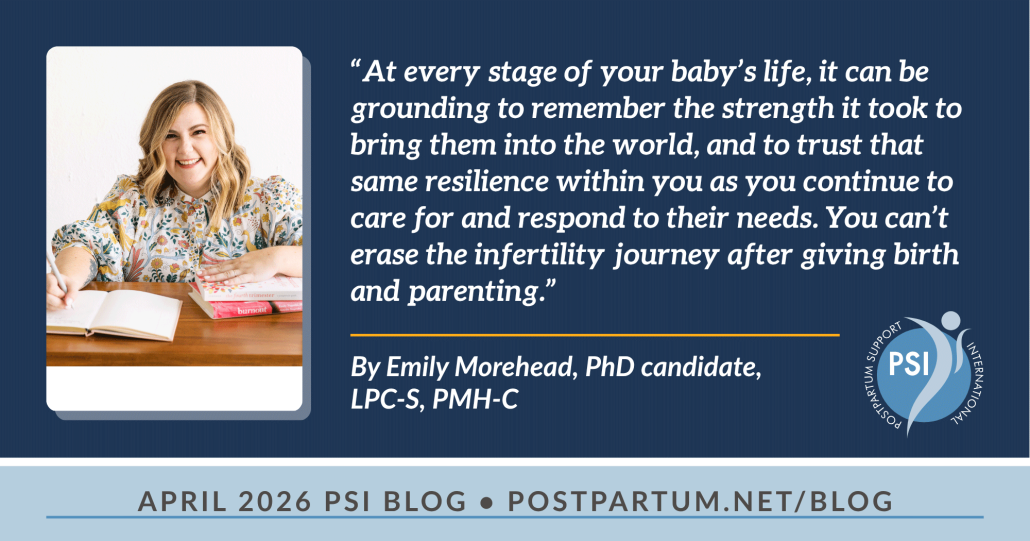
At every stage of your baby’s life, it can be grounding to remember the strength it took to bring them into the world, and to trust that same resilience within you as you continue to care for and respond to their needs. You can’t erase the infertility journey after giving birth and parenting.
Reflecting back to my own journey many years ago, I am reminded that my fertility struggles taught me everything I needed to know about my own capability to love.
If you are pregnant or parenting after infertility, you aren’t alone, and Postpartum Support International has resources that can offer you help and support! You don’t have to do this alone.
References
American Society for Reproductive Medicine. (2023). Defining infertility. ReproductiveFacts.org. https://www.reproductivefacts.org/news-and-publications/fact-sheets-and-infographics/defining-infertility/
Chandra, A., Copen, C. E., & Stephen, E. H. (2013). Infertility and impaired fecundity in the United States, 1982–2010: Data from the National Survey of Family Growth (National Health Statistics Reports No. 67). National Center for Health Statistics. https://www.cdc.gov/nchs/data/nhsr/nhsr067.pdf
About the Author

Emily Morehead
Emily Morehead is a Co-Owner, Psychotherapist, and Clinical Supervisor at The Couch Therapy, PLLC. Emily is a PhD candidate in Marriage and Family Therapy at Texas Woman’s University. She recently completed the Sexual Health Certificate Program at the University of Michigan, focusing on Sex Therapy. Emily engages in academic research projects and serves as an instructor in courses in Human Sciences, Counseling and Marriage and Family Therapy for both bachelor’s and master’s level coursework.
As the co-owner and clinical supervisor at The Couch Therapy, PLLC, Emily provides psychotherapy to individuals, couples, and groups, supervises pre-licensed clinicians, and conducts reproductive third-party consultations and psychological evaluations. She is also responsible for practice development, community relations, and clinician training.
Emily has spoken at local, state, and international mental health and relationship conferences and was recently named Editor’s Choice by TEDx. Emily has published papers in Parents’ and Huffington Post. Emily’s current research interests are diverse and include estrangement, clinical supervision best practices, sexual health, maternal mental health and parenting. Connect with Emily on Instagram, Facebook, and TikTok.
The views and opinions expressed in this blog are those of the author and do not necessarily reflect the official policy, position, or views of PSI, its leadership, employees, affiliates, or partners. Any content provided by the author is for informational purposes only and should not be construed as representing PSI’s official stance on any matter.
Explore these PSI Resources:
Connect with PSI’s Fertility Challenges Specialized Coordinator
Explore PSI’s Peer Support Groups
Professional Trainings and Webinars
Subscribe to the PSI Blog

Connect by PSI
Download our free app “Connect by PSI” in your app store to access PSI support, resources, and information in the palm of your hand.


