Sexual Health Awareness Week: Why Screening Matters for Everyone
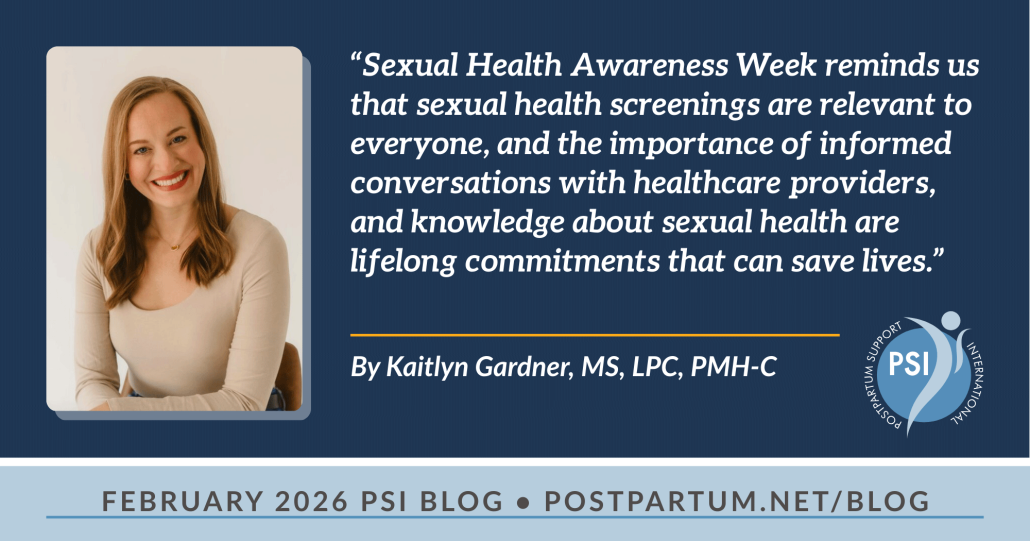
By Kaitlyn Gardner, MS, LPC, PMH-C
Sexual Health Awareness Week is an opportunity to highlight sexual health as a core part of overall health. In our busy lives, we often forget the importance of screening, education, and access to care for sexually transmitted infections and conditions, including human papillomavirus (HPV), HIV, chlamydia, gonorrhea, and many others. Sexual health screenings can bring about fear and anxiety. However, sexual health screenings not only help in diagnosing concerns and diseases but also reduce serious health outcomes through prevention and early detection.
Unfortunately, I know all too well the impact of ignoring your sexual health. When I was postpartum, navigating recovery and parenthood, I did not expect to confront a cancer diagnosis. HPV is extremely common. Persistent infection with high-risk HPV types is the primary cause of cervical cancer. Research shows that comprehensive screening for HPV, including HPV testing, significantly reduces cervical cancer incidence and death by identifying precancerous changes early (Arbyn, M., et al., 2020).
Prioritizing Preventive Care
Screening is not limited to cervical health. Sexual health screenings encompass a wide range of infections. Studies consistently show that routine testing improves outcomes and reduces transmission, yet stigma, lack of awareness, and access barriers prevent many people from being tested (Datta, S., et al., 2021). During the postpartum period, sexual health can be deprioritized, yet this period is a critical time to prioritize preventive care.
Sexual Health Clinics
For many, the most effective way to take control of sexual health is by visiting a trusted healthcare provider or sexual health clinic. Going to a clinic allows you to receive comprehensive screening for a range of sexually transmitted infections, including HPV, chlamydia, gonorrhea, HIV, and syphilis, as well as counseling on prevention and vaccination options. During these visits, healthcare providers can answer questions, provide guidance based on your personal and family health history, and help you create a plan for regular screenings. Clinics also serve as a gateway to additional resources, such as educational materials, support groups, and referrals for follow-up care if results require further evaluation. Knowing where to access these services is an important step; local health departments, family planning centers, and organizations like Planned Parenthood and Postpartum Support International can help connect you to sexual health services in your community. Seeking care in person can reduce uncertainty, ensure accurate testing, and provide reassurance and support, particularly for new parents who may feel overwhelmed or unsure about how to prioritize their own health.
Self-Sampling Kits and Other Screening Programs
Studies also show that offering self-sampling kits directly to individuals increases participation compared to requiring patients to request a kit (Pattyn, J., et al., 2022). Integrated screening programs that test for multiple infections simultaneously have also been effective in identifying asymptomatic infections in low-income populations (Pattyn, J., et al., 2022). Despite these advances, participation in sexual health screening remains suboptimal. Clear communication from healthcare providers has been shown to improve understanding, reduce anxiety, and encourage follow-up care (McBride, E., et al., 2021).
Sexual Health Awareness Week reminds us that sexual health screenings are relevant to everyone, and the importance of informed conversations with healthcare providers, and knowledge about sexual health are lifelong commitments that can save lives.
References
Arbyn, M., et al. (2018). “Accuracy of human papillomavirus testing on self-collected versus clinician-collected samples: meta-analysis.” BMJ, 363, k4823.https://www.bmj.com/content/363/bmj.k4823
Arbyn, M., et al. (2020). “Detection of cervical precancer and cancer with HPV testing: a systematic review and meta-analysis.” The Lancet Oncology, 21(8), 1013-1028. https://doi.org/10.1016/S1470-2045(20)30383-7
Datta, S., et al. (2021). “Screening for sexually transmitted infections in the United States: 2015–2019.” Journal of Public Health, 43(4), e614–e623.https://academic.oup.com/jpubhealth
Meites, E., et al. (2020). “Integrating STI testing with HPV self-collection: a public health approach.” JAMA Network Open, 3(6), e208341. https://jamanetwork.com/journals/jamanetworkopen/fullarticle/2768602
McBride, E., et al. (2021). “Patient experience and communication in HPV testing: a systematic review.” BMC Health Services Research, 21, 628.https://bmchealthservres.biomedcentral.com/articles/10.1186/s12913-021-06283-w
Pattyn, J., et al. (2022). “Direct mailing of HPV self-sampling kits increases participation in cervical cancer screening.” BMC Public Health, 22, 1988. https://bmcpublichealth.biomedcentral.com/articles/10.1186/s12889-022-14123-0
Verdoodt, F., et al. (2015). “HPV self-sampling for screening non-attenders: meta-analysis of randomized trials.” BMJ, 350, h2450. https://www.bmj.com/content/350/bmj.h2450
About the Author

Kaitlyn Gardner, MS, LPC, PMH-C
Kaitlyn is the co-owner of The Quiet Grove in Fort Smith, Arkansas. In her private practice, she works with women navigating anxiety, depression, reproductive trauma, and major life transitions, drawing on her training in EMDR and her personal experiences with miscarriage, cervical dysplasia, cervical cancer, and hysterectomy. These experiences inform her empathetic and authentic approach to supporting clients. Kaitlyn has a particular clinical interest in obsessive-compulsive disorder (OCD) and in providing care to individuals and families after infant loss. She lives in Arkansas with her husband, daughter, and two extremely entitled cats.
Explore These PSI Resources:
Perinatal Mental Health Discussion Tools
Get Help
Provider Directory
Subscribe to the PSI Blog

Connect by PSI
Download our free app “Connect by PSI” in your app store to access PSI support, resources, and information in the palm of your hand.