
The Inseparable Crisis: Why Black Maternal Health is Black Infant Mental Health
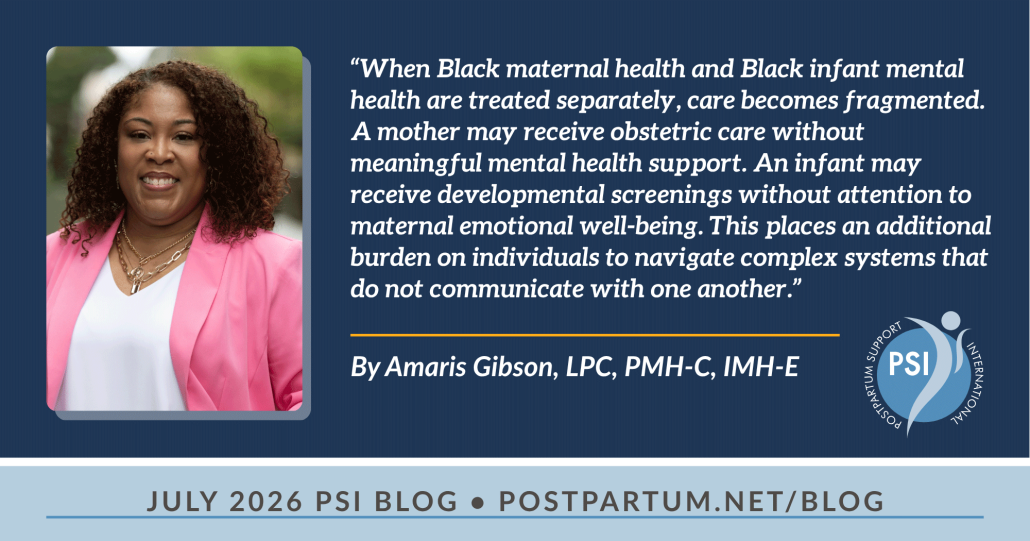
By Amaris Gibson, LPC, PMH-C, IMH-E
The link between Black maternal health and Black infant mental health is inseparable, yet these areas are often treated as distinct issues in healthcare and public policy. Factors such as systemic racism, chronic stress, and socioeconomic disparities create generational cycles of poor health outcomes that affect both mother and child, which demands that we must explore a more integrated approach to care for Black families. In this blog, we will discuss how the well-being of the mother directly and profoundly impacts the infant’s development and mental health, and how both have suffered disproportionately from systemic inequities.
Bridging Black maternal health and Black infant mental health is a necessary perspective shift if we are to witness thriving Black families for generations to come.
The Inseparable Link Between Black Maternal Health and Black Infant Mental Health
Black maternal health and Black infant mental health are deeply interwoven and interconnected. Despite this understanding, healthcare systems, research, and public policy address these issues as two siloed crises. This division neglects a critical truth: the well-being of Black mothers directly shapes the cognitive, social, emotional, and relational development of her infant. These impacts don’t begin at birth; they are forged within the womb.
In order to support Black families and improve generational wellness, we have to shift away from segmented care to a more integrated approach to early relational health. Just as a mother and fetus share a physical body during pregnancy, they share the emotional and psychological impacts of their environment. A mother’s mental health influences not only her well-being but also the foundational emotional experiences that guide her infant’s lifelong health and sets the stage for generations that follow
Infant Mental Health Is Relational Health
Infant mental health does not begin at birth- it begins in the womb. The mother-infant connection begins before birth. Many times, we prioritize a mother’s physical health during pregnancy, yet her mental and emotional state are equally as important. A mother’s wellness plays a significant role in overall fetal development. Stress, nutrition, sleep, physical and emotional safety all influence a baby’s brain development. Infant Mental Health employs a two-generation approach by focusing on the relationship between the infant and their primary caregiver. This approach recognizes that the well-being of a child is directly linked to the well-being of their parent or caregiver. Instead of treating the child or the caregiver in isolation, this model works with the dyad to strengthen their bond and interactions, hence why it has also been referred to as early relational health. The mother–infant dyad is the first mental health system.
When Black maternal mental health is supported, Black infants are more likely to experience:
- Secure attachment relationships
- Healthy stress regulation systems
- Strong emotional and relational development
- Improved long-term mental health outcomes
Conversely, when Black maternal health is compromised and unsupported within inequitable systems, infants are more vulnerable to dysregulation, attachment disruptions, and later mental health challenges.
Systemic Stress and Generational Impact
The lived experiences of Black mothers, both prior to and during pregnancy, can not only increase chances of maternal and infant mortality, but can only have an impact on the infant’s mental health. The cumulative stress burden or “weathering”, as tokened by Dr. Arline T. Geronimus, affects not only maternal well-being but also the development of the infant. Weathering can leave Black mothers in constant survival mode, which means emotional presence becomes harder—not because of lack of love, but because of depleted capacity. Prolonged toxic stress can impact bonding, emotional regulation, and the capacity for attuned caregiving. Maternal and infant stress exacerbate each other and impair caregiving and the quality of attachment.
Black families in the United States face disproportionate rates of exposure to chronic stress:
- Racial discrimination in healthcare settings
- Higher rates of maternal morbidity and mortality
- Economic inequities and housing instability
- Limited access to quality mental health care
- Historical and intergenerational trauma
The stressors can impact a mother’s mental health. Perinatal distress is often underdiagnosed and undertreated in Black mothers. Black mothers in the United States experience postpartum depression at higher rates than white mothers, with estimates suggesting up to 40% of Black mothers are affected. Despite this higher risk, they are less likely to receive treatment. Black mothers are less likely to be screened for postpartum depression, less likely to be referred for counseling, and often face systemic barriers in receiving care. Maternal mental health during pregnancy and postpartum is crucial for infant mental health, as it significantly impacts the mother-infant relationship, attachment, and the child’s social-emotional and cognitive development.
We must ponder the question: What happens to a baby’s emotional world when the mother’s injustice, distress and oppression is unseen?
An Integrated and Collective Approach to Care
When Black maternal health and Black infant mental health are treated separately, care becomes fragmented. A mother may receive obstetric care without meaningful mental health support. An infant may receive developmental screenings without attention to maternal emotional well-being. This places an additional burden on individuals to navigate complex systems that do not communicate with one another.
Bridging Black maternal health and Black infant mental health requires a shift in both mindset and practice. Care must become relational, integrated, and community-informed.
A more holistic approach includes:
- Dyadic care models that treat mother and infant as a unit
- Trauma-informed maternal mental health support during pregnancy and postpartum
- Early relational health interventions that strengthen bonding and attachment
- Community-based support systems, including extended family, faith communities, doulas, and peer networks
- Culturally responsive care providers who understand the lived realities of Black families
This is not only a clinical shift—it is a cultural and systemic one. It requires recognizing that generational healing does not happen in isolation. It happens in relationships, communities, and environments that acknowledge systemic harm and advocate for more holistic, culturally attuned care.
A Necessary Perspective Shift
Bridging Black maternal health and Black infant mental health is not optional—it is necessary if we are committed to seeing Black families not just survive, but thrive across generations.
When we care for Black mothers, we are caring for Black infants.
When we support Black infants, we are supporting Black mothers.
These are not separate systems of care—they are one interconnected system of life, development, and relational health.
To continue treating them separately is to miss the full picture. To integrate them is to begin addressing the root of systemic inequities and to move toward healing that is truly sustainable from generation to generation.
About the Author

Amaris Gibson, LPC, PMH-C, IMH-E® Infant Mental Health Specialist, Reflective Supervisor
Amaris Gibson, LPC, PMH-C, IMH-E® Infant Mental Health Specialist, Reflective Supervisor, is a licensed professional counselor and advocate in the field of Infant and Early Childhood Mental Health and Perinatal/Maternal Mental Health. She has over a decade of experience serving young children and families in different capacities throughout the state of South Carolina.
She is the founder of Queendom Come Coaching, where she provides relationship-focused individual, couples and family therapy. Amaris is trained in multiple evidenced-based interventions to support parent-child relationships and disrupt intergenerational trauma. As a therapist, trainer, and storyteller, Amaris creates engaging therapeutic learning environments to explore family dynamics and foster relational healing. Her passion for familial and community health drives her to share her belief that relationships can be healing.
Amaris’s most important relationships are with the ones who inspire her to continue this work: her husband, two children and extended family and friends. Connect with Amaris on Facebook: Queendom Come Coaching and Instagram: @queendom_come_coaching.
The views and opinions expressed in this blog are those of the author and do not necessarily reflect the official policy, position, or views of PSI, its leadership, employees, affiliates, or partners. Any content provided by the author is for informational purposes only and should not be construed as representing PSI’s official stance on any matter.
Explore these PSI Resources:
Resources for BIPOC Families
Postpartum Planning Class
Resources for Professionals
Subscribe to the PSI Blog

Connect by PSI
Download our free app “Connect by PSI” in your app store to access PSI support, resources, and information in the palm of your hand.


