
There’s a Group For That
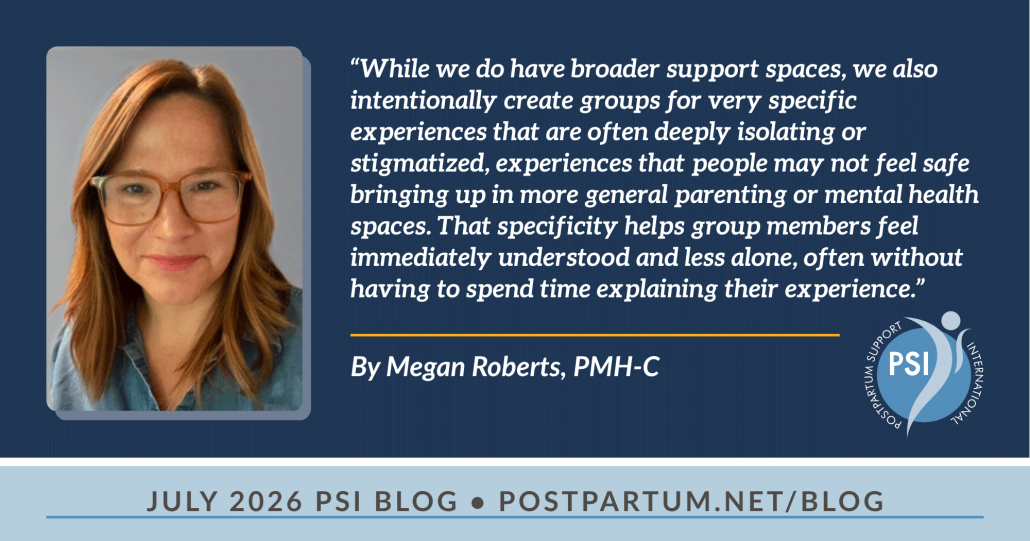
A Conversation with Megan Roberts, PMH-C, PSI Peer Support Program Manager
“I’m grateful for the opportunities to meet with other moms who may be struggling like I am. It helps me not feel so alone and isolated. It allows me to put a voice to my difficult experiences.”
— Perinatal Mental Health Support for Moms Group Member


Megan, you have years of experience as a peer support specialist. What are some benefits of peer support in the perinatal period?
One of the things people don’t talk about enough is how isolation can intensify postpartum overwhelm. When you’re stuck in your own head with those difficult thoughts and feelings, they tend to get louder. Having real support, especially from people who get it, can turn down that intensity in a really meaningful way.
Peer support spaces are powerful because they provide a space for group members to be fully honest about their experiences. You can say the thoughts you might not say out loud anywhere else, and instead of being judged or “fixed,” you’re met with someone who can just sit with you and understand. That empathy and connection can be a huge relief.
And maybe most importantly, this kind of support helps reduce shame. There’s also something incredibly grounding about realizing, oh… It’s not just me.
What can a parent expect from a Postpartum Support International (PSI) peer support group?
Our groups are designed to create a sense of community and belonging. They’re led by trained peer facilitators: people who truly understand experiences like postpartum depression and anxiety, infant loss, fertility challenges, or after termination. This isn’t a clinical or formal space. It’s a place where you can show up exactly as you are without any judgment.
Each session is 90 minutes on Zoom (through the Sharewell platform), and everything shared in the group is confidential. You don’t have to worry about saying the “right” thing or having it all figured out.
When you join, you’ll likely find a mix of people: some who are ready to talk, others who are just there to listen. Both are completely okay.
What tends to happen in these spaces is something really powerful but simple:
- People share pieces of their story
- Others listen, relate, and gently reflect back
- You start to realize you’re not the only one carrying what you’re carrying
Most people leave feeling less alone, a little more understood, and a bit more hopeful than when they came in.
Samantha: PSI now offers over 50 groups to meet the needs of all kinds of parents, facing all kinds of situations. Can you speak to how the program has grown?
The growth of our program is based on group member requests and filling gaps within the perinatal support space. Group members provide feedback after every group session, and we read every piece of feedback each week. We truly listen to this feedback and what group members are asking for. This is how specific groups like Pregnancy After Stillbirth, Postpartum Rage, or Trying to Conceive After Loss were initiated: group members asked for them. We now serve around 1,400 group members per month, hold about 45-50 sessions per week with the help of 205 volunteer facilitators.
Tell us about how you and the peer support team determine the need for a new specific support group.
First, we listen to feedback and requests from group members and the PSI community. Then we begin to research if there is a gap in this topic area. We ask questions like: is anyone else already providing this type of support, and are we the best fit for this topic, or should we connect with another organization?
Once the need for a new group is determined, what does the planning process look like?
The first step is consulting with experts in the topic area. We connect and consult with those who have learned and lived experience with the topic. For instance, when we began exploring one of our newer groups, Autistic Moms and Birthing People Support, we consulted with two top researchers in the field and a therapist who has spent over 20 years working with this population. We then consulted with several parents with lived experience. During this exploratory learning phase, we ask questions like “Who should this group be for?” “What special considerations should we think about in terms of format and group guidelines?” “What barriers could get in the way of this population finding us or attending?”
After this research phase, we must begin our search for peer facilitators. This step takes recruitment, interviews, observations, and training. Then, together with the peer facilitators, we create some psychoeducation for the group, write a group description, and collaborate with our Marketing team on a group graphic.
What are some obstacles you face when preparing to start a new group?
The first obstacle is program capacity. We have to consider the time and programmatic resources a new group will take. Then we must consider if we are able to reach this population well enough to have a robust group. Lastly, we want to make sure we have a deep enough knowledge to support this population. Do we know the best, most inclusive language to use? Are we able to find facilitators who have the same lived experience and can hold space?
What things do you consider when seeking a support group facilitator? What does the training process look like?
We’re looking for someone with lived experience in that specific group topic. For instance, for a group like termination for medical reasons, a peer facilitator needs to have experienced a TFMR. We also want our peer facilitators to have the capacity to hold space and give support. This usually means they are at least a year postpartum or a year post-loss. We do not require any professional expertise, though many of our facilitators do have professional experience. We are happy to train facilitators in every aspect of our groups. From beginning to end, the onboarding process contains the following steps: application, interview, observe a session, training videos, attend live 2-hour training. We also ask for a one-year commitment from our volunteers.
What is unique about PSI groups?
I think one of the most unique things about PSI groups is the level of specificity and nuance we offer. While we do have broader support spaces, we also intentionally create groups for very specific experiences that are often deeply isolating or stigmatized, experiences that people may not feel safe bringing up in more general parenting or mental health spaces. That specificity helps group members feel immediately understood and less alone, often without having to spend time explaining their experience.
Another thing that sets PSI groups apart is that we’re very intentional. Each group follows clear guidelines and a consistent format so members know what to expect every session. Facilitators are trained to prioritize inclusivity and nonjudgmental support rather than advice-giving or fixing.
Thank you so much for sharing a behind-the-scenes look at PSI’s support groups. What else would you like to share with us?
For anyone who feels hesitant to join a group, I really want people to know that PSI groups are free, there’s no long-term commitment, and you can simply come and see how it feels.
During my own postpartum period, I felt incredibly hopeless. I joined a local peer support group out of desperation, and honestly, I didn’t think it would help. I remember assuming no one could really understand how overwhelmed and alone I felt. But being in a space with people who truly got it changed something for me.
Peer support was the first kind of support that made me feel less alone and gave me genuine hope. It helped me get through one day, then the next day, and eventually helped me believe that I wouldn’t always feel the way I did in those hardest moments. I think that’s the power of these groups: not fixing people, but helping them feel seen and connected while they move through something really difficult.
About the Author

Megan Roberts, PMH-C
Megan is a perinatal peer support specialist. Prior to working in perinatal mental health, Megan was an English professor; her passion and career shifted after having her first child and her own perinatal mental health challenges in 2014. For 10 years, Megan has managed perinatal support groups (first locally and now for PSI). Since 2021, Megan has worked for Postpartum Support International as their English Support Groups Program Manager, managing over 200 volunteer group leaders who help to serve around 1,400 help seekers per month in peer support groups. She has certifications from Group Peer Support, Mental Health First Aid, Circle of Security Parenting, and the Racial Equity Institute. She lives with her partner, three children, a dog, cats, and a lot of houseplants.
Interview conducted by Postpartum Support International’s Samantha Reaves, MA, PMH-C.
Explore these PSI Resources:
PSI’s Free, Online Peer Support Groups
PSI’s Specialized Support Resources
PSI’s Postpartum Planning Class
Subscribe to the PSI Blog

Connect by PSI
Download our free app “Connect by PSI” in your app store to access PSI support, resources, and information in the palm of your hand.


![“Pregnancy is often portrayed as a time of hope, yet for many it is marked by fear, control, and harm. Understanding [intimate partner violence (IPV)] prevalence, risks, and the life-saving role of safety planning is essential to supporting survivors with compassion and care.” Navigating Pregnancy While Experiencing Intimate Partner Violence By Alejandra M. Esparza, LPC, LCDC, EMDR-Certified](https://postpartum.net/wp-content/uploads/2026/07/Navigating-Pregnancy-While-Experiencing-Intimate-Partner-Violence_Esparza.png)