
Tolerating Uncertainty as a Queer Parent in Unprecedented Times
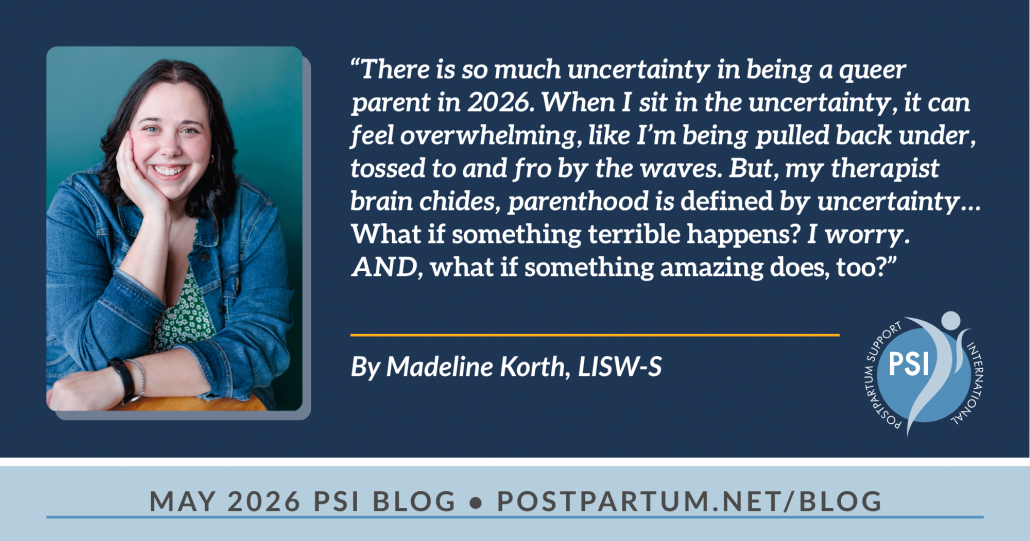
By Madeline Korth, LISW-S
Feeling Helpless
Starting in November of 2024, I started each day with a worrisome pattern: jolt into consciousness at the sound of my baby’s cries, soothe, change, feed, and check the news on my phone. It was never good news.
It had been three months since giving birth, and I was submerged in postpartum depression. I remember the hope and optimism my partner and I felt on election day as we dressed our daughter in a purple peace-sign onesie and tiny striped pants, walking together to our polling place. I remember the way my heart softened in my chest, thinking about her growing up with a female president. I remember the crash, later that night, when sundown scaries set in, and I prepared for another disjointed night of sleep, and they called the election in the wee hours of the morning.
Awake each night at one, and three, and five, strapped to a breast pump with a swaddled newborn in the bassinet beside me, I found very little to do besides stare at my phone to pass the time. I consumed Reddit threads about increasing milk supply, reels soberly reminding that fostering secure attachment begins in infancy, and New York Times updates about the latest domino to fall as politicians radically restructured our country while Americans sat, helpless.
I started — and ended — each day terrified.
The Risk of Visibility
I came out as queer in 2013 while away at college in South Carolina. I had accepted it for myself a year or two earlier, but didn’t feel like coming out was an option at my rural New Hampshire high school. Who would I even date, anyways? I told myself. It’s not like anyone else here is gay. It wasn’t until I was firmly in the heart of the Bible Belt, away from everyone and everything I had known for eighteen years, that it felt possible.
But I quickly learned that with visibility comes risk. Shortly after the 2016 election, my now-partner and I were walking home at night when someone leaned out of their car window to yell slurs at us. It rattled me, but it wasn’t the first time something like that had happened. I’d actually prided myself in being unbothered when people were homophobic toward me, insistent that nothing and no one would change who I am. That moment walking home with my masculine-of-center partner was when it clicked for me — my privilege as someone who is white and straight-passing. It was the first moment I realized that as the political tides changed, that risk would grow, and I might not be able to protect everyone I loved. The uncertainty was gutting.
Earlier in our relationship, I would find myself frustrated about being misread as a straight couple. It felt like people would see a masculine person and a feminine person, and make incorrect assumptions about us. After having our daughter in 2024, those gendered assumptions amplified, but I noticed something surprising. Passing as straight still felt bad, like a part of our relationship was being misconstrued, but it also offered protection.
Parenting Through Uncertainty
Since the election, we’ve had many hushed conversations that feel like contingency planning. If gender-affirming care is banned in our state, will we leave? There is so much attention on LGBTQIA+ people and pregnant people right now — what will I do if my therapy practice is targeted? Our daycare receives state and federal funding — if that goes away, can we afford it?
There is so much uncertainty in being a queer parent in 2026. When I sit in the uncertainty, it can feel overwhelming, like I’m being pulled back under, tossed to and fro by the waves.
But, my therapist brain chides, parenthood is defined by uncertainty. There is so much we can’t know, can’t predict. I would be lying if I said this administration hadn’t affected my family, my practice, or the way I move through the world. Just as I say to my clients, it’s a dialectic; a both-and statement.
I don’t know what will happen, AND I know life will go on.
I am scared for my family’s safety, AND I am hopeful.
What if something terrible happens? I worry. AND, what if something amazing does, too?
Strategies to Cope with Uncertainty
- Focusing on what can be known, rather than what is unknown. For example: I know that I’m here, now, and I’m safe and healthy. I feel my feet on the ground, the earth beneath me, and so on.
- Resisting the urge to time travel, either into the past to see what has happened before, or to the future to predict what will happen.
- When I’m really overwhelmed, practicing the same slow breath technique I teach my daughter: we pantomime deeply smelling a flower, then blowing out a candle in a fast burst.
Now, I sit on my front steps and feel the warm breeze kiss my cheeks, ruffle through my daughter’s tawny curls. I breathe deep and blow bubbles that take flight as they catch the wind, swirling up and away from her as she cackles in delight. I feel my phone buzz in my pocket; it’s another New York Times notification. I remember to be here, now, and not time-travel to the worst-case scenario future. I can’t know everything, and that has to be okay.
About the Author

Madeline Korth
Madeline Korth is a licensed independent social worker with a Master of Science in Social Administration (MSSA) from Case Western Reserve University. Her clinical work focuses on LGBTQIA+ individuals, sex therapy, perinatal mental health, and the treatment of anxiety disorders and trauma. In addition to seeing clients in private practice, Maddy has given presentations on mental health topics throughout Northeast Ohio and published numerous blogs and articles about mental health, substance use, and LGBTQIA+ identity. Outside of the office, you can find her chasing her toddler on the playground or at the local library.
The views and opinions expressed in this blog are those of the author and do not necessarily reflect the official policy, position, or views of PSI, its leadership, employees, affiliates, or partners. Any content provided by the author is for informational purposes only and should not be construed as representing PSI’s official stance on any matter.
Explore these PSI Resources:
Queer and Trans Parents Support Group
Connect with our LGBTQIA+ Parents Support Coordinator
In an Emergency
Subscribe to the PSI Blog

Connect by PSI
Download our free app “Connect by PSI” in your app store to access PSI support, resources, and information in the palm of your hand.


