
Inclusive Perinatal Mental Health Care: Supporting Queer Families During the Transition to Parenthood
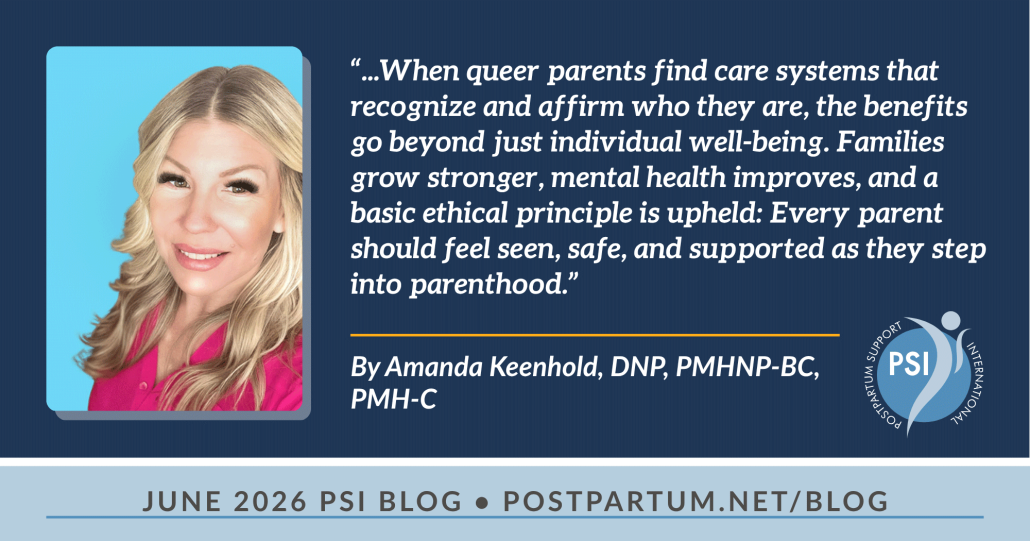
By Amanda Keenhold, DNP, PMHNP-BC, PMH-C from Denova Collaborative Health
Pride Month
Pregnancy and the time after birth often bring up many different emotions. While many people feel love and happiness, it is also common to experience uncertainty, anxiety, or self-doubt.
The perinatal period is a time when mental health challenges are more likely. Queer families especially often face additional stressors as they move through healthcare systems. Although it is improving in some places, they commonly find that the industry is mostly designed for heterosexual people, and may experience things like heteronormativity, cisnormativity, and gaps in provider knowledge.
Difficulty in securing inclusive care can lead to an increase in mental health distress (Kirubarajan et al., 2022). Each year, about 635,000 births, or one in six, are to sexual minority women, who have higher rates of postpartum depression than heterosexual women (Lapping-Carr et al., 2023; Kirubarajan et al., 2022).
Perinatal mental health providers play a vital role in shaping compassionate, ethical, and effective mental health care for queer families. Truly inclusive care begins with recognizing the rich diversity among families, understanding the unique challenges they encounter, and embracing clinical practices that help every parent step confidently into their new role.
Understanding the Diversity of Queer Families
Queer families represent a broad and diverse community. LGBTQ+ parents may include:
- lesbian couples
- gay male parents via surrogacy
- transgender or nonbinary gestational parents
- bisexual parents in different-gender partnerships
- single LGBTQ+ parents
- co-parenting families
Family formation pathways can also differ from those of many heterosexual families. Common routes to parenthood for LGBTQ+ families are donor conception, assisted reproductive technologies, surrogacy, adoption, or reciprocal IVF. Before pregnancy even begins, these families can experience barriers such as legal and financial systems that are not always designed to support LGBTQ+ individuals.
Unique Stressors and Barriers
Although all expecting couples navigate mental health challenges, LGBTQ+ families often face extra hurdles that shape their journey in distinct and sometimes unexpected ways. For instance, generic perinatal mental health interventions may not address minority stress-related factors that drive distress in LGBTQ+ families. Minority stress occurs on multiple levels for these parents.
External stressors can prevent couples from seeking care due to societal attitudes in some communities. While there has been improvement, they can still face prejudice, discrimination, or invalidation. All of these factors can create an emotional burden, leading to feelings of being misunderstood and unsupported by family members and friends.
Non-gestational parents experience increased vulnerability during the perinatal period, especially when their roles are minimized or unrecognized. Ensuring that they are included in conversations about infant care, support services and mental health screening can ensure that the entire family is receiving mental health care.
What Does Inclusive Perinatal Care Look Like?
Creating an affirming environment through documentation of correct pronouns, inclusive language, and staff training can significantly improve mental health outcomes and increase engagement in care among LGBTQ+ individuals (Heggie et al., 2023).
Case Vignette: Navigating Pregnancy as a Transgender Parent
Alex, a transgender man, presented for prenatal care in his second trimester. Despite disclosing his gender identity, he was repeatedly referred to as “mom,” and all educational materials used gendered language. Over time, he began delaying appointments due to anticipatory distress.
By the third trimester, Alex endorsed symptoms consistent with perinatal depression, including low mood, withdrawal, and difficulty connecting with the pregnancy. He also described heightened vigilance in clinical settings, shaped by prior negative experiences. From a trauma-informed perspective, repeated misgendering functioned as ongoing micro-invalidations, contributing to disengagement from care.
These experiences are well documented. Transgender and gender diverse individuals report higher rates of discrimination in healthcare, which is associated with psychological distress and care avoidance (American College of Obstetricians and Gynecologists, 2021).
Language Shifts That Make a Difference
| Instead of | Try |
| Mother | Parent or birthing parent |
| Father | Parent or partner |
| Breastfeeding mother | Lactating or chestfeeding parent |
| Maternal mental health | Perinatal mental health |
| Expectant mother | Expectant parent |
Clinical Practice Modifications
- Train all staff in appropriate ways to ask about names, pronouns, and family structures
- Avoid assumptions about sexual orientation, sexual practices, or family composition
- Use intake forms with inclusive options for gender identity and sexual orientation, or provide write-in spaces
- Review office spaces to ensure images, signage, and educational materials represent diverse family structures
- Recognize and validate both parents’ mental health needs, not just the birthing parent
- Understand that non-birthing parents may experience role confusion and need explicit inclusion
- Provide access to inclusive peer support and mental health services
No two families experience the perinatal period the same. When healthcare systems overlook and fail to affirm the unique challenges of queer families, the resulting stress can be profound. However, when queer parents find care systems that recognize and affirm who they are, the benefits go beyond just individual well-being. Families grow stronger, mental health improves, and a basic ethical principle is upheld: Every parent should feel seen, safe, and supported as they step into parenthood.
Affirming Resources for Patients
Queer & Trans Parent Support Group – Postpartum Support International (PSI)
Embodied Birth Class: Queer/Trans Childbirth Education— A live, community-based program for queer & trans people navigating birth, taught by a trans genderqueer professional midwife.
Family Equality Council– A variety of resources for LGBTQ families from book lists to family groups, to support groups, to education events, and more.
The Neighborhood: A Virtual Hub for LGBTQ+ Families by Family Equality– Find a range of peer support spaces.
Queer + Pregnant – A Pregnancy Journal by Cedar Rivers at Love Over Fear Wellness– A downloadable journal for your pregnancy journey. (Buy the hardcopy here.)
For Healthcare Workers
LGBTQIA Inclusive Pregnancy And Birth Care by Lex Londino on Inspired Birth Pro– This is a great introduction for doulas. Plus, there’s a huge resource list for continued education and exploration.
Providing Inclusive Services and Care of LGBT People, A Guide for Health Care Staff by National LBGT Health Education Center– There’s a lot of education packed into these 25 pages.
LGBTQ+ Training for Professionals from Family Equity–Trainings for family-building providers who are supporting queer and trans folks. Check out their scholarship opportunity for queer and trans birthworkers here!
References
American College of Obstetricians and Gynecologists. (2021). Health care for transgender and gender diverse individuals (Committee Opinion No. 823). https://doi.org/10.1097/AOG.0000000000004294
Cronin, B., & Stockdale, C. K. (2021). Health care for transgender and gender diverse individuals (Committee Opinion No. 823). Obstetrics & Gynecology, 137(3), e75–e88. https://doi.org/10.1097/AOG.0000000000004294
Heggie, C., Cowal, G., MacIntosh, C., & Paynter, M. (2023). Supportive and affirming queer perinatal health care: A qualitative study. LGBTQ+ Family: An Interdisciplinary Journal, 19(5), 405–415. https://doi.org/10.1080/27703371.2023.2242319
Kirubarajan, A., Barker, L. C., Leung, S., Ross, L. E., Zaheer, J., Park, B., Abramovich, A., Yudin, M. H., & Lam, J. S. H. (2022). LGBTQ2S+ childbearing individuals and perinatal mental health: A systematic review. BJOG: An International Journal of Obstetrics & Gynaecology, 129(10), 1630–1643. https://doi.org/10.1111/1471-0528.17103
Lapping-Carr, L., Dennard, A., Wisner, K. L., & Tandon, S. D. (2023). Perinatal depression screening among sexual minority women. JAMA Psychiatry, 80(11), 1142–1149. https://doi.org/10.1001/jamapsychiatry.2023.2619
About the Author

Amanda Keenhold,
DNP, PMHNP-BC, PMH-C
Dr. Keenhold is a board-certified Psychiatric Mental Health Nurse Practitioner with over 15 years of experience in the behavioral health field. She’s working now with Denova Collaborative Health, Arizona’s largest provider of behavioral health services, where she provides compassionate, evidence-based care to both adolescents and adults, tailoring treatment to each individual while emphasizing holistic wellness.
Keenhold earned her BSN from Grand Canyon University and her DNP from the University of Arizona. In addition to her PMHNP certification through the ANCC, she is also certified in Perinatal Mental Health (PMH-C), reflecting her dedication to supporting individuals through pregnancy, postpartum, and beyond. She is an active member of multiple professional nursing organizations and is passionate about supporting patients through all stages of life.
The views and opinions expressed in this blog are those of the author and do not necessarily reflect the official policy, position, or views of PSI, its leadership, employees, affiliates, or partners. Any content provided by the author is for informational purposes only and should not be construed as representing PSI’s official stance on any matter.
Explore these PSI Resources:
Resources for Professionals
Resources for Queer and Trans Parents
Peer Support Groups
Subscribe to the PSI Blog

Connect by PSI
Download our free app “Connect by PSI” in your app store to access PSI support, resources, and information in the palm of your hand.


