The Potential Cost of Honesty in PMAD Screening: Why so many parents feel they can’t be truthful—and what we can do about it
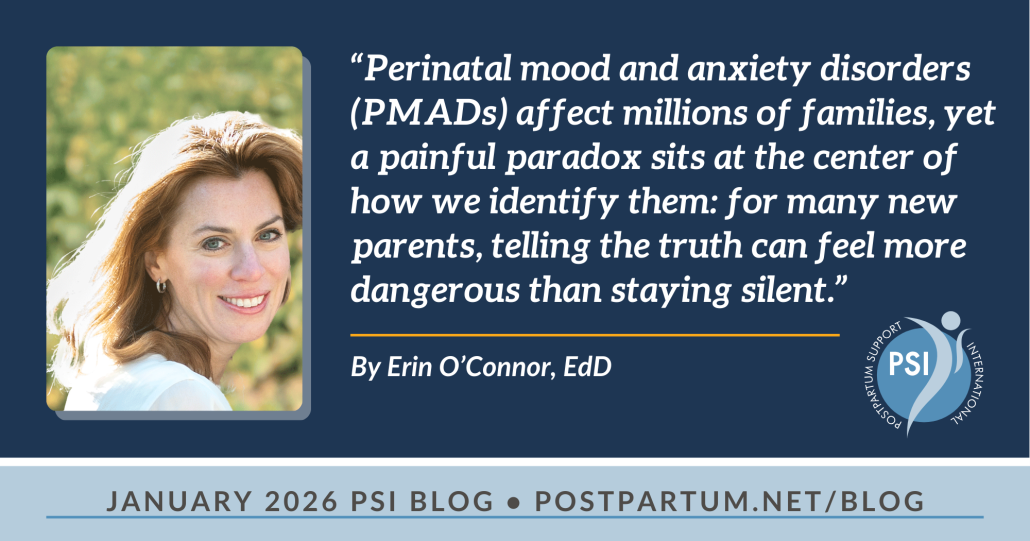
By Erin O’Connor, EdD, Co-Founder of Nested, New York University Professor, Board Member of All Parents Welcome
Perinatal mood and anxiety disorders (PMADs) affect millions of families, yet a painful paradox sits at the center of how we identify them: for many new parents, telling the truth can feel more dangerous than staying silent.
A recent national survey conducted by Nested in partnership with New York University found that among caregivers who were screened for PMADs, only half reported answering honestly. The majority admitted withholding symptoms out of fear that disclosure would lead to being labeled unfit—or worse, separated from their child.
Parents described memorizing how to “pass safely,” strategically selecting answers to avoid scrutiny rather than reflect reality. One caregiver wrote that her biggest barrier to honesty was “fear that my child would be taken away from me if I was honest about how crazy I felt.” Another shared fearing forced hospitalization or custody loss, “no matter how irrational that sounds.”
This fear is not fringe. Parents may recognize the classic symptoms of PMADs—depression, anxiety, intrusive thoughts, and emotional volatility—as treatable mental health concerns. But for many parents, screening environments don’t feel clinical; they feel surveilled.
When Speaking Up Feels Too Risky
Many caregivers report that screenings—especially standardized tools like the Edinburgh Postnatal Depression Scale (EPDS)—feel rushed, shallow, or like a box-ticking exercise designed to protect providers, not patients. Parents described the process as “a trap instead of a tool to provide help,” admitting they concealed anxiety and intrusive thoughts by selecting uniform high scores that looked “safe but believable.”
One mother captured the bind starkly:
“No one ever prepared me for this. I felt so alone and scared for me and my baby, but also scared to seek help out of fear of my baby being taken away.”
When parents feel that truth may trigger child-protective intervention rather than care, silence becomes self-preservation. But the consequences are real: untreated PMADs are associated with relational strain, impaired bonding, and reduced emotional availability—exactly the conditions early screening is meant to prevent.
Why Providers Struggle Too
Fear thrives in ambiguity, and ambiguity thrives where training is thin.
Frontline healthcare professionals want to support families, but many feel underprepared. Pediatricians often lack access to maternal histories and may feel PMADs fall outside their clinical lane. OB/GYNs report limited training in PMAD pharmacological treatment beyond a small set of familiar medications, commonly expressing discomfort managing complex mental health presentations.
Even more concerning: clinicians frequently report not knowing what to do after a positive screen, asking, “If my patient screens positive, what do I do with them?” When providers lack confidence, families sense it, and the screening becomes a cliff instead of a bridge.
The System is Working Exactly as Designed—And That’s the Problem
If fewer than half of caregivers feel safe being honest during screening, we don’t have a measurement problem. We have a trust problem.
And trust can’t be repaired by tools alone. It’s repaired through conditions:
- Transparency about confidentiality, parents’ rights, and what does (and does not) trigger mandated reporting
- Warm human follow-up instead of clipboard silence
- Cultural signals that distress is not disqualification
- Clinical capacity to provide support without escalating unnecessarily
Screening should open doors, not close them.
What We Can Do About It
Here are evidence-aligned, psychologically-grounded steps to reset the landscape:
1. Lead with psychological safety
Screening must begin with explicit assurances of confidentiality and plain-language explanation of mandated reporting thresholds. Parents should never wonder whether vulnerability equals custody risk.
2. Train providers to respond with nuance, not alarm
Trauma-informed, rights-affirming PMAD training should be standard in medical and early childhood care settings, helping providers distinguish between treatable distress and true crisis and respond without reflexive escalation.
3. Replace checkbox silence with relational follow-through
A screen should always be followed by a brief, warm conversation, an offer of resources, and a next step that keeps parents connected to care—not fearful of it.
4. Build perinatal mental health into the care ecosystem
Integrate PMAD specialists into OB and pediatric practices. Normalize the fourth trimester as a window of mental health support, not evaluation.
We Can’t Make Parents Choose Between Their Baby and Their Truth
Honesty shouldn’t be costly. It should be catalytic.
Screenings only work when caregivers believe disclosure leads to care, not consequences. And right now, millions of parents don’t believe that.
The fix isn’t convincing parents to be braver. It’s building systems that make bravery unnecessary.
About the Author

Erin O’Connor, EdD
Erin O’Connor, EdD, is a Full Professor and Director of Early Childhood Education at New York University, where she studies how relationships with caregivers and teachers impact child development. She is also the co-founder of Nested, a nonprofit research institute focused on caregiver mental health and family well-being. Erin holds advanced degrees from Harvard, Columbia, and Fordham, and her work has been featured in leading psychology and education journals. She co-hosts the Parenting Understood podcast and is passionate about translating research into action for families.
Explore These PSI Resources:
Information on Perinatal Mental Health
Professional Perinatal Mental Health Training
Provider Directory
Subscribe to the PSI Blog

Connect by PSI
Download our free app “Connect by PSI” in your app store to access PSI support, resources, and information in the palm of your hand.