
The Shadow in Your Smile, Inspired By One Mother’s Battle With Depression and Bipolar Disorder
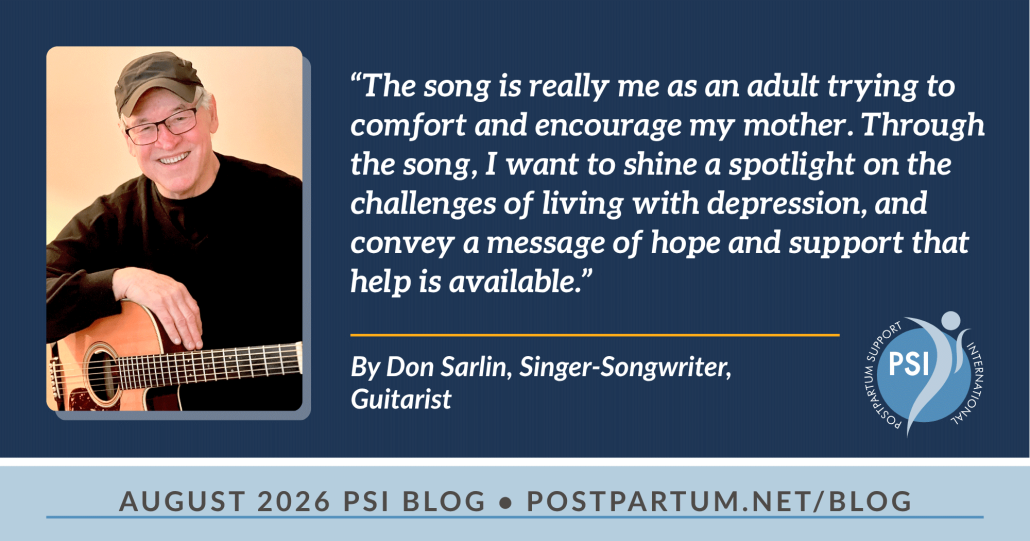
A Conversation with Don Sarlin, Singer-Songwriter, Guitarist
“I see the shadow in your smile
I see it as you turn away
It’s like a dark cloud passing over
Hiding sunlight from the day
I know you’d never say you’re hurtin’
I know confession’s not your style
But of one thing I am certain
That’s the shadow in your smile”
Words from Don:

My mother, Lilian Bass Sarlin, suffered from profound depression and bipolar disorder, which manifested with the passing of her mother-in-law, with whom she was very close, in the mid-1950s, when treatment options were limited and quite primitive. I was five at the time, the youngest of three children. My mother was hospitalized for about a year around that time, remaining under treatment and symptomatic for the rest of her life. She never really escaped the challenges of the condition, and passed away in the mid-1980s. I wrote this song inspired by her experience.
I got the inspiration for the song when I learned of friends’ experiences with postpartum depression, and read about how common postpartum challenges are today. It brought back memories of my mom’s difficulties, and the look in her eyes (the “shadow”) that betrayed her efforts to conceal her sadness for much of her life. The song is really me as an adult trying to comfort and encourage my mother. Through the song, I want to shine a spotlight on the challenges of living with depression, and convey a message of hope and support that help is available.
Q: Thank you for sharing your beautiful, yet heartbreaking, song with us. Will you share with us what the process was like writing this song?
Don: Of course, Samantha, and thank you for the kind words. Writing the song was a pretty emotional experience. I first experimented with writing it from the perspective of my five-year-old self, expressing the confusion and upset of a young child. John Lennon’s Mother, a song of childhood abandonment, came to mind. I stopped, finding it upsetting and without a path to convey a message of comfort. I then tried writing from the perspective of a sister-in-effect me as an adult – who could offer comfort and the promise of better days to come, and that felt right. The music, which has a mariachi feel to it, was directly inspired by Linda Ronstadt’s 1987 spanish-language album, Canciones di mi Padre, with her heartfelt singing and haunting mariachi melodies – I’d heard it streaming while the song was coming to life. When it came to recording it, I recruited a fine, empathic vocalist, good friend (and a mom) Iris Schaffer Hall, joined by her partner Doug Hall.
Q: We’d love to hear more about Lilian – who she was, apart from her struggles with mental health.
Don: Mom was quite a dynamic woman in her youth, with a feisty personality and a fine sense of humor and adventure. She grew up in a working-class immigrant family in New York who operated a candy store. She at first studied fashion design, but managed by dint of her intelligence and personality to go to work as an assistant to legendary Broadway producer and talent agent Leland Hayward (South Pacific, The Sound of Music), hanging with such characters as young Jerry Siegel and Joe Shuster, creators of Superman, and traveling to Europe. She derived great pleasure from being a mother to myself and my two older brothers. Even during her most trying times her wicked sense of humor would re-emerge. “Manic depression is fun half the time,” she once observed, in the days before “bipolar” entered the lexicon.

Q: Although there is still a long way to go in supporting new parents, we have come a long way, increasing awareness and resources related to perinatal mental health. What do you think may have been different for your mother if she had experienced her struggles today?
Don: My mom’s struggles began in the mid-1950s when treatment was rudimentary, crude, and sometimes debilitating. Support was quite limited and friends and community in post-war America had little familiarity with the condition, making it a source of embarrassment and social isolation. Today she would no doubt have benefited from the far greater understanding of depression and bipolar disorder, the much more effective pharmacological options available and the excellent support networks that exist to help individuals with her challenges.
Q: You have shared with us that your mother struggled with her mental health for most of your life. How did this affect you as you were growing up? As an adult?
Don: Growing up my mom’s condition could throw our home in an uproar, with much tension resulting. My father, a teacher of limited means, struggled to provide for the family, give his sons the attention we needed when my mom was not in shape to do so, and secure care for her. As an adult, I think I developed a desire to avoid confrontation and conflict, often acting as a conciliator in my personal and professional life.
Q: How did your mother’s experience with depression shape your own understanding of mental health?
Don: I think it gave me a heightened sense of empathy for folks struggling with such challenges, even as a child. According to family legend, at about 10 years old I returned home a bit bloodied from a confrontation with a neighborhood kid who’d started the fight. When my mother said she was going to tell his mother, I pleaded, “Please don’t, Mom – he’s got problems.”
Q: Postpartum Support International wants every mother and new parent to know, “You are not alone. You are not to blame. With help, you will be well.” How does this message resonate with you?
Don: It goes straight to my heart, and I can only wish my mom had received such support when she needed it most.
Q: As someone who has struggled with postpartum depression, I can say you have done a beautiful job in capturing what it felt like at times. There were many days I struggled to put on my makeup or felt overwhelmed caring for my baby. As a songwriter, will you share your perspective on transforming someone’s lived experience into lyrics?
Don: I think details are the lifeblood of songs. I try to provide the specifics from which the listener can derive the themes and the overarching message, resisting the urge to preach. One of my favorite songwriters is John Prine, who wrote Angel From Montgomery, replete with detail and atmosphere, and which Bonnie Raitt recorded and has probably sung at every show for over 50 years. I strive to create worlds the listener can inhabit.
Q: You shared that you want the song to shine a light on the challenges of living with depression and convey a message of hope. What call to action do you have for listeners?
Don: If there is a message I’d hope to impart, it is for friends and family to be on the lookout for that “shadow” and encourage a mother to seek help.
Q: Is there anything else you’d like to share?
Don: Just my sincere gratitude for the chance to talk about this with you, Samantha. And thanks so much to you and your organization for helping folks successfully navigate the challenges my mom faced.
About the Author

Don Sarlin
Don Sarlin, guitarist and songwriter, has toured with Van Morrison, David Bromberg, Mary Travers, and others. His time on stage with such folks inspired him to write songs of his own. He’s described his works as “screenplay songs,” capturing characters, a plot, a place and a time and performing them with memorable solo guitar instrumentals as well. Hear Don’s music at donsarlin.com.
Interview conducted by Postpartum Support International’s Samantha Reaves, MA, PMH-C.
Explore these PSI Resources:
Learn More about Perinatal Mental Health Disorders
Get Help
Donate in Honor of a Loved One
Subscribe to the PSI Blog

Connect by PSI
Download our free app “Connect by PSI” in your app store to access PSI support, resources, and information in the palm of your hand.


