
Boot Camp for New Dads Rises to the Challenge
By Bob Bath
Welcome to Boot Camp: Rookies Meet Veterans
For almost 11 years now, I’ve had the joy of facilitating a monthly training session called Boot Camp for New Dads. My interest in providing the class started out while I was driving to UCSF to help my own child move out of the dorms as her dreams of becoming a pharmacist needed to change. A program on NPR’s Fresh Air came on about teaching kids who never had a father to become fathers. I was soon in tears, since my dad was my hero, as well as that of my siblings. Since I work out next to an OB/GYN, I had a plethora of questions about how to distribute a brochure while working around HIPAA rules. She swatted each concern away, and within two weeks I was being trained in Denver, CO.
As you can imagine, the participants in boot camp for new dads are diverse. The youngest first time dad in my chapter was 15; the oldest, 62. Many of our “rookie dad” registrants know that they are at their best when they have a “game plan” and appreciate that the class is taught by dads who have a child between 2 and 10 months old who we refer to as a “veteran dad.” These dads want to flourish, not survive fatherhood. Sadly, some dads already know they are facing co-parenting custodial issues and/or need to prove to a judge that they are fit for custody.
After introductions, which include whether or not the parent knows the gender and when the baby is due, the lesson plan has me asking, “What type of father did you have?” Answers range from “Absent. I never knew him.” to “Present, but distant.”; “A child; he never grew up.”; “Alcoholic.”; “Abusive.”; “Workaholic.” Every so often, we also hear, “He showed how to treat my mom; took me camping, fishing, hunting.”; “Present for my sports events (or even coached them).”; “My dad taught me everything.”
Next, I pose the question, “It’s 60 years down the road. Your child is putting you into the ground. What are three words that your child will use to describe you at your eulogy? What type of father do you want to be?” The most common answers are, “Great listener.”; “The perfect mix of provider and present.”; “My teacher.” I am fond of summarizing, “Our passions become our kids’ passions; their passions become our passions.”
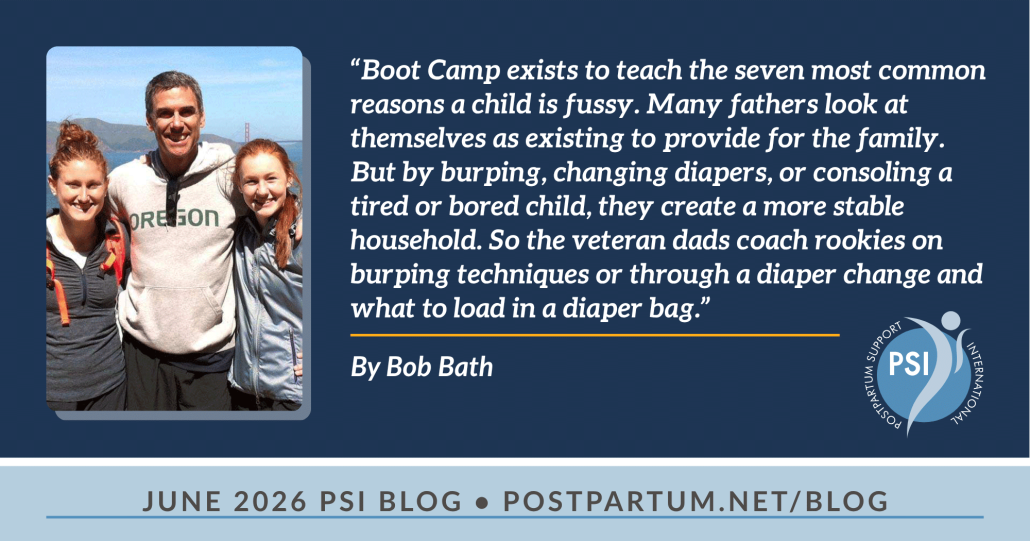
In the movie Taken, Liam Neeson asserts, “What I do have are a particular set of skills.” Boot Camp exists to teach the seven most common reasons a child is fussy. Many fathers look at themselves as existing to provide for the family. But by burping, changing diapers, or consoling a tired or bored child, they create a more stable household. So the veteran dads coach rookies on burping techniques or through a diaper change and what to load in a diaper bag.
Tears and Fears
One of the most humorous moments is when I simulate a baby undergoing “Purple Crying.” Generally it happens around 5 pm, and I set the scene by explaining, “Your partner is so impressed with you that she left you and the baby to go to Target (30 mins. away) to pick up diapers and meet up with friends for coffee.” I get within 18 inches of the rookies’ faces and begin irritable fussiness, gradually ramping up to a full-blown wail.
At each stage, I ask, “What are you going to do?!” Most dads refer back to their checklist of the seven reasons. Soon, all of the rookie dads are wide-eyed and clearly stressed. “You’re at DEFCON 5, dads, you are SERIOUSLY in danger of doing what we all do with something that isn’t working, like electronic equipment. We shake it! What are you going to do?” About 50% of the time, one of the rookies will eventually say, “Put the baby down and walk away.” ALL of the veteran dads affirm that this situation definitely occurs and lead the rookies in the boot camp mantra, “Baby, I love you too much to ever shake you.”
The other moment that I particularly enjoy in the lesson plan is discussing the “protector” role. As men, we no longer need to fight off saber-tooth cats. So what will we be protecting our children from? The answers are insightful:
- Myself. I used to think nothing about tossing back a couple of drinks and hopping into the car. Now, I don’t want to take a chance that I’ll miss my baby’s first steps or changing a diaper or feeding my baby because of a selfish decision.
- FOMO (Fear of Missing Out). I don’t want my child to suffer anxieties because they are addicted to social media and getting “liked” by friends.
- The list continues: Choking hazards. The dog. My guns. COVID and other illnesses. Family members who smoke or drink or give unsolicited advice that contradicts pediatricians and common sense. Stairs. Pulling a bookcase on top of itself. Swallowing poisons under the sink.
“So rookies, how many months do you think you have before you need to have your childproofing done?” Blank stares, but another magnificent moment of bonding between the rookies and veterans.
The 4th Trimester
But the most unanticipated moment for rookies learning about their role as protector, is hearing about the “4th trimester,” when moms often suffer from postpartum depression or baby blues. The rookie dads realize at this time how vital it is to step up and pull parenting tasks — as well as chores that have previously been his partner’s — onto his own plate. Men who’ve not been the best at communicating with their partner need to make it a point to “check in” on mom’s mental well-being; help her reestablish an exercise routine; surround her with her friends and relatives, and recognize those instances when it might be necessary to activate the health care team because she needs more help than these supports can provide.
I’ve since learned that “Family-Friendly” is a health care provider code for “Breast is Best.” This happened when I attempted to distribute a poster to a potential Boot Camp supporter. The poster had a father feeding his baby milk from a bottle. “I’m sorry, Mr. Bath, but we cannot support your program.” As I learned that this group favored breast milk, I tried to reason, “Men are not equipped to nurse babies,” and “We don’t know if this is formula in the bottle or freshly expressed milk.” It didn’t matter. So we use a “Dad the Adventurer” themed poster for such healthcare groups.
Brotherhood of Fatherhood
Due to the positive feedback from evaluations, I wish I could teach the course once per week instead of once per month. The program is self-sustaining, since rookie graduates are eager to show off their children and impart their wisdom in our “Brotherhood of Fatherhood.” Some rookies have Zoomed in from Portland or Salem, hours away.
Sadly, men are largely an independent breed, and feel strongly that they’ll be able to “figure it all out without some class.” Some men just don’t commit to things, period. But for the men who attend, I challenge them: “Women are great at getting together to discuss kids as well as deep concerns and joys. Men? Not so much, unless we’ve tossed back a good IPA or two first. I challenge you to give me permission to disclose your e-mail addresses to each other, and meet each other at the local sports park. Walk your kids in their strollers. Talk about milestones, or share your birth story.” In fact, some of my Boot Camp classes have done so.
Boot Camp Across the Nation
Diana Suskind notes in her book Parent Nation, “A child’s education begins on the first day of life, not the first day of school.” In our “United” States, we have some states who give parents paid leave, and some that expect parents to “figure it out” in advance and either quit or be at work the next day. We have states that have legalized marijuana, a drug that, like alcohol, depresses the nervous system and makes users less likely to fully engage with their child and stimulate motor neurons, setting them up for myriad learning problems later on. We have parents who read and sing to their children, and those who fail to understand how important that is. I celebrate the work of the 260 chapters of Boot Camp for New Dads nationwide, and am proud to be a facilitator.
About the Author

Bob Bath
Bob holds an MA in Science Education and hosts Boot Camp for New Dads on the second Saturday of each month at one of two venues in the Rogue Valley of Oregon.
Explore these PSI Resources:
Resources for Dads and Partners
Explore PSI Peer Support Groups
More on Perinatal Mental Health
Subscribe to the PSI Blog

Connect by PSI
Download our free app “Connect by PSI” in your app store to access PSI support, resources, and information in the palm of your hand.


![“Cactus In Bloom works to increase awareness and disrupt the cycle of child sexual abuse on a systemic level by filling the gap in care for [survivors] who are family planning, perinatal, and parenting, and shaping a culture that has the tools to actively disrupt childhood sexual abuse.” Disrupting the Intergenerational Cycle of Childhood Sexual Abuse A Conversation with Ebony Williams, LMFT, Founder and Executive Director of Cactus In Bloom](https://postpartum.net/wp-content/uploads/2026/06/Disrupting-the-Intergenerational-Cycle-of-Childhood-Sexual-Abuse_Williams.png)